DEFR14A: Revised definitive proxy soliciting materials
Published on April 3, 2026
UNITED STATES
SECURITIES AND EXCHANGE COMMISSION
Washington, D.C. 20549
SCHEDULE 14A
Proxy Statement Pursuant to Section 14(a) of the Securities
Exchange Act of 1934
(Amendment No. 1)
Filed by the Registrant x
Filed by a Party other than the Registrant ¨
Check the appropriate box:
¨ Preliminary Proxy Statement
¨ Confidential, For Use of the Commission Only (as permitted by Rule 14a-6(e)(2))
x Definitive Proxy Statement
¨ Definitive Additional Materials
¨ Soliciting Material under §240.14a-12
| Deluxe Corporation | ||
| (Name of Registrant as Specified in Its Charter) | ||
| (Name of Person(s) Filing Proxy Statement, if Other Than the Registrant) | ||
| Payment of Filing Fee (Check the appropriate box): | |||||
| x | No fee required. | ||||
| ¨ | Fee paid previously with preliminary materials: | ||||
| ¨ | Fee computed on table in exhibit required by Item 25(b) per Exchange Act Rules 14a-6(i)(1) and 0-11 | ||||
i
EXPLANATORY NOTE
April 3, 2026
This Amendment No. 1 to Schedule 14A (“Amendment No. 1”) is being filed to amend and restate portions of the definitive proxy statement of Deluxe Corporation (the “company,” “Deluxe,” “we,” “our,” or “us”) made available to our shareholders in connection with the solicitation of proxies for the 2026 Annual Meeting of Shareholders to be held on April 23, 2026 (the “2026 Annual Meeting”), which was filed with the Securities and Exchange Commission (the “SEC”) on March 9, 2026 (the “Original Proxy Statement”). This Amendment No. 1 is being filed with the SEC on April 3, 2026. Only shareholders of record at the close of business on February 23, 2026, are entitled to vote at the 2026 Annual Meeting and at any adjournment thereof.
The purpose of this Amendment No. 1 is to amend and restate the sections of the Original Proxy Statement entitled “Stock Ownership and Reporting,” “Executive Compensation Discussion and Analysis” and “Compensation Tables” in their entirety as set forth below to correct the individuals identified as named executive officers and update the related disclosure and to make other immaterial adjustments to the deferred compensation earnings in the Summary Compensation Table. Except as described in this Amendment No. 1, the information provided in the Original Proxy Statement continues to apply. If information in this Amendment No. 1 differs from or updates information contained in the Original Proxy Statement, then the information in this Amendment No. 1 is more current and supersedes the different information in the Original Proxy Statement. THIS AMENDMENT SHOULD BE READ IN CONJUNCTION WITH THE ORIGINAL PROXY STATEMENT.
IF YOU HAVE ALREADY VOTED BY INTERNET, TELEPHONE, OR BY MAIL, YOU DO NOT NEED TO TAKE ANY ACTION UNLESS YOU WISH TO CHANGE YOUR VOTE. Proxy voting instructions already returned by shareholders (via Internet, telephone, or mail) will remain valid and will be voted at the 2026 Annual Meeting unless revoked. Important information regarding how to vote your shares and revoke or change your vote already cast is available in the Proxy Statement under the captions “How do I vote my shares?” and “Can I change my vote?”
ii
STOCK OWNERSHIP AND REPORTING
Security Ownership of Certain Beneficial Owners and Management
The following table shows, as of February 23, 2026 (unless otherwise noted), the number of shares of common stock beneficially owned by: 1) each person or entity known by us to beneficially own more than five percent of our outstanding common stock; 2) each executive officer named in the Summary Compensation Table (SCT) that appears in the "Compensation Tables" section of this Proxy Statement (each, a NEO); 3) each director and nominee for director; and 4) all of the current directors, director nominees, and executive officers as a group. Except as otherwise indicated in the footnotes below, the shareholders listed in the table have sole voting and investment powers with respect to the common stock owned by them.
| Name of Beneficial Owner | Amount and Nature of Beneficial Ownership | Percent of Class | ||||||
| 5% Beneficial Owners | ||||||||
BlackRock, Inc.1 50 Hudson Yards New York, NY 10001 | 6,672,012 | 14.9 | ||||||
The Vanguard Group, Inc.2 100 Vanguard Blvd. Malvern, PA 19355 | 4,995,852 | 11.4 | ||||||
State Street3 One Congress Street, Ste. 1 Boston, MA 02114 | 2,606,087 | 5.8 | ||||||
Dimensional Fund Advisors, LP4 6300 Bee Cave Road, Building One Austin, TX 78746 | 2,361,658 | 5.3 | ||||||
| NEOs | ||||||||
Barry C McCarthy5 | 1,153,262 | 2.5 | ||||||
William C. Zint6 | 117,611 | * | ||||||
Tracey G. Engelhardt7 | 220,682 | * | ||||||
Yogaraj Jeyaprakasam8 | 154,992 | * | ||||||
Jeffrey L. Cotter9 | 207,818 | * | ||||||
| Directors and Nominees | ||||||||
Angela L. Brown10 | 22,818 | * | ||||||
Michelle T. Collins11 | 6,279 | * | ||||||
Hugh S. (Beau) Cummins III10 | 10,349 | * | ||||||
Paul R. Garcia10 | 41,577 | * | ||||||
Cheryl E. Mayberry McKissack10 | 79,447 | * | ||||||
Thomas J. Reddin12 | 50,238 | * | ||||||
Morgan M. (Mac) Schuessler, Jr.10 | 10,349 | * | ||||||
John L. Stauch10 | 77,650 | * | ||||||
Telisa L. Yancy10 | 55,333 | * | ||||||
All Directors, Director Nominees and Executive Officers as a group (19 persons)13 | 2,527,433 | 5.4 | ||||||
* Less than 1 percent of the class.
(1)Based on the most recent Schedule 13G/A filed with the SEC, reporting that such beneficial owner and its affiliates have sole dispositive power over 6,672,012 shares and sole voting power over 6,582,535 shares.
(2)Based on the most recent Schedule 13G/A filed with the SEC, reporting that such beneficial owner and its affiliates have sole dispositive power over 4,869,836 shares and sole voting power over 0 shares, shared voting power over 80,972 and shared dispositive power over 126,016.
(3)Based on the most recent Schedule 13G filed with the SEC, reporting that such beneficial owner and its affiliates have sole dispositive power over 0 shares, sole voting power over 0 shares, shared dispositive power over 2,606,087 and shared voting power of over 2,482,725 shares.
(4)Based on the most recent Schedule 13G filed with the SEC, reporting that such beneficial owner and its affiliates have sole dispositive power over 2,361,658 shares and sole voting power over 2,286,312 shares.
(5)Includes 432,754 shares receivable upon the exercise of options that are currently exercisable or will be exercisable within 60 days, and 261,984 RSUs.
1
(6) Includes 3,906 shares receivable upon the exercise of options that are currently exercisable or will be exercisable within 60 days, and 57,816 RSUs.
(7)Includes 44,477 shares receivable upon the exercise of options that are currently exercisable or will become exercisable within the next 60 days, and 60,589 RSUs.
(8)Includes 56,180 RSUs.
(9)Includes 90,529 shares receivable upon the exercise of options that are currently exercisable or will become exercisable within the next 60 days, and 48,725 RSUs.
(10)Includes 10,349 RSUs.
(11)Includes 6,279 RSUs.
(12)Includes 28,731 RSUs, of which 18,382 were issued pursuant to the director's decision to defer certain fees or equity awards.
(13)Includes 642,811 shares receivable upon the exercise of options exercisable within the next 60 days, and 725,998 RSUs, of which 18,382 were issued pursuant to directors' decisions to defer certain fees or equity awards.
Delinquent Section 16(a) Reports
Section 16(a) of the Exchange Act, and its related regulations, require our directors and executive officers, and any persons holding more than ten percent of our common stock, to report their initial ownership of our securities and any subsequent changes in that ownership to the SEC. Based solely on our review of such forms furnished to us and written representations from certain reporting persons, we believe that all Section 16(a) reports applicable to our directors, executive officers and 10% stockholders were filed in a timely manner in 2025.
2
EXECUTIVE COMPENSATION DISCUSSION AND ANALYSIS
Executive Summary
In this Compensation Discussion and Analysis (CD&A), the Compensation and Talent Committee (referred to as the Committee throughout this CD&A and the compensation tables following this CD&A) describes the principles of our executive compensation program, how we applied those principles in compensating our NEOs for 2025, and how we use our compensation programs to motivate effective executive performance aligned to our overall company goals. The following discussion should be read in conjunction with the various tables and accompanying narrative disclosure appearing in this Proxy Statement. The table below identifies our NEOs.
| Named Executive Officer | Title at the End of 2025 | Years in Position at End of 2025 (rounded) | Years of Service at End of 2025 (rounded) | ||||||||
| Barry C. McCarthy | Director, President and Chief Executive Officer | 7 | 7 | ||||||||
| William C. Zint | Senior VP, Chief Financial Officer | 3 | 5 | ||||||||
| Tracey G. Engelhardt | Senior VP, President, Print | 4 | 31 | ||||||||
| Yogaraj Jeyaprakasam | Senior VP, Chief Technology and Digital Officer | 4 | 4 | ||||||||
| Jeffrey L. Cotter | Senior VP, Chief Administrative Officer, General Counsel and Corporate Secretary | 8 | 8 | ||||||||
Fiscal 2025 Performance Highlights
During fiscal year 2025, we performed well and are progressing our strategy to invest the predictable returns from our Print business lines to drive growth across Merchant Services, B2B Payments, and Data Solutions. We also drove continued operating leverage and made notable progress toward our earnings and cash flow acceleration objectives under North Star, as we completed the program. We continued to invest in our technology and product development platforms, primarily in our growth businesses. Our One Deluxe cross-selling model also yielded positive results.
Specific highlights from our operating segments are as follows:
•Our Merchant Services segment, which contributed 19% of our 2025 revenue, grew 3.8% over the previous year, driven by new merchant and customer wins across our direct, FI partner, ISO, and ISV selling channels.
•Our B2B Payments segment, which contributed 14% of our 2025 revenue, grew 0.9% as we continued to migrate toward our digital offerings. We exited 2025 with a year-over-year fourth quarter growth rate of 4.5% in this business, returning to our expected growth trajectory after lapping prior year one-time revenue.
•Our Data Solutions segment, which contributed 14% of our 2025 revenue, grew 31.3% from the previous year, continuing to demonstrate our success deploying an optimized set of data-driven marketing capabilities for our customers. Our growth extended across our core FI customer base, and we expanded into adjacent customer markets.
•Our Print segment, which contributed 53% of our 2025 revenue, declined 5.7% from the previous year, driven by continued forecasted secular declines and demand headwinds across areas of legacy promotional solutions, net of our annual pricing activity, consistent with our expectations.
For purposes of compensation under our AIP, we used metrics of comparable adjusted revenue, comparable adjusted EBITDA, and comparable adjusted EPS at the enterprise level. For 2025, there were no differences between the Company's comparable adjusted metrics and the Company's adjusted metrics.
Our enterprise revenue was $2.133 billion, which included $398.6 million for our Merchant Services segment, $290.5 million for our B2B Payments segment, $307.3 million for our Data Solutions segment, and $1.137 billion for our Print segment. In FY 2025, we reported adjusted EBITDA of $431.5 million and adjusted EPS of $3.61.
CEO Realizable Pay Versus Target Pay 2023–2025
In keeping with our pay for performance philosophy, the Committee designed our compensation program to ensure that the realized value our executives receive is closely aligned with company performance. Since 2023, our executives successfully transformed our business. We have further rationalized the portfolio, driven continued operating leverage, making notable progress toward our earnings and cash flow acceleration objectives, and
3
continued to invest in our technology and product development platforms, primarily in our growth businesses. Leadership has driven robust execution, creating strong operating leverage across the business as both earnings and cash flow growth have outpaced revenue trajectories. At the same time, the actual pay our executives realized has been less than target prior to 2025.
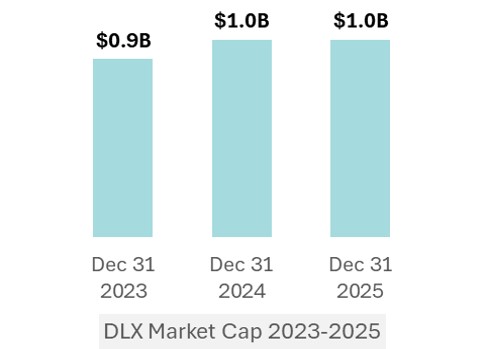
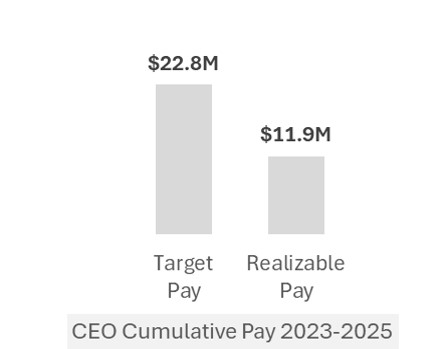
The following assumptions and calculations were used for purposes of the charts above:
•Cumulative target pay for 2023–2025 includes base salary paid during each of the three years, target AIP pay for each year, and the grant date fair values of long-term equity incentives awarded. Equity-based awards are valued as determined under ASC Topic 718.
•Cumulative realizable pay for 2023–2025 includes base salary paid during each of the three years, actual AIP pay received for each year, the market value of shares released for long-term equity incentive awards, and the intrinsic value of long-term equity award shares outstanding as of December 31, 2025. This calculation uses the $22.33 per share closing stock price as of December 31, 2025, and assumes that unvested PSUs are earned at target.
•The market capitalization for Deluxe at the beginning of the three year period 2023–2025 was $0.9 billion.
Compensation Philosophy
The Compensation and Talent Committee designed our executive compensation program to reflect the dynamics of the markets in which we compete for talent. In constructing an overall compensation program, the Committee balances those components that are fixed (such as base salary and benefits) against components that are variable and require the achievement of certain levels of performance. The Committee also strives for a balance between compensation components that reward executives for the achievement of short-term goals with those that focus on our long-term growth. Each year the Committee reviews the form and value of long-term equity incentive grants to ensure alignment with our overall compensation philosophy and to reward attainment of our enterprise-wide goals. The Committee structures the executive pay to ensure a significant percentage is performance-based, comprised of both annual and long-term incentive awards. A substantial portion of each executive's total compensation is directly linked to our stock price and driven by the company’s performance. The Committee also acknowledges that additional compensation may occasionally be necessary to reward extraordinary efforts or retain key executives.
Our 2025 incentive pay included both short- and long-term incentives, in the form of annual cash bonus incentives and RSUs and PSUs. This design was intended to ensure that the actual compensation earned by NEOs is aligned with company performance and, by extension, with shareholders’ interests. The charts below illustrate the mix of
4
2025 base salary, time-based RSUs, and performance-based incentives (annual incentives and PSUs), presented at the target level of performance, for our President and CEO and our other NEOs.
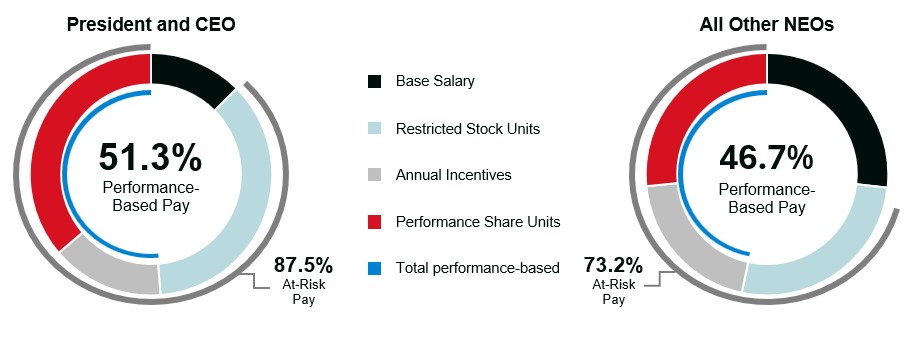
The composition of our 2025 AIP and our long-term equity incentive program is summarized in the table below.
Incentive Program | Objective | Award Type | Performance Metrics, Weightings, and Vesting | ||||||||
| AIP | Encourages and rewards valuable contributions to our annual financial and operational performance objectives | 100% cash | 40% enterprise comparable adjusted revenue and/or business unit revenue | ||||||||
| 30% enterprise comparable adjusted EBITDA | |||||||||||
| 10% enterprise comparable adjusted earnings per share | |||||||||||
| 20% strategic initiatives | |||||||||||
| RSUs | Helps retain talent and aligns NEOs' incentives with the interests of our shareholders | 50% of total long-term incentive value | Three-year ratable vesting | ||||||||
| PSUs | Rewards share price performance on both an absolute and relative TSR basis | 50% of total long-term incentive value, with payouts determined based on achievement of defined performance metrics, subject to a relative total shareholder return (TSR) modifier | 50% of PSUs—three-year cumulative revenue target | ||||||||
| 50% of PSUs—three-year cumulative free cash flow target | |||||||||||
| Final PSU results are subject to a relative TSR modifier based on relative TSR ranking as compared to a relevant index | |||||||||||
See the “Annual Incentive Plan” and “Long-Term Incentive Compensation” sections below for descriptions and discussion of specific metrics and targets.
5
President and CEO and Other NEO Target Compensation
We have an employment agreement with Barry C. McCarthy, our President and CEO. The table below describes the components of his 2025 target compensation package, which is unchanged since 2023. According to market research performed by the Committee's independent advisor, FW Cook, Mr. McCarthy's compensation package falls between the 25th and 50th percentiles of our peer group, which is discussed in more detail under "Our Company's Peer Group" below. In setting the 2025 target compensation, the Committee determined that the 2025 compensation levels were within competitive market practices and aligned with investor priorities and company performance.
| Element | Key Features | ||||
| Base Salary | •Annual base salary of $950,000, unchanged since 2023 | ||||
| AIP | •Target annual incentive payout of 120% of base salary, unchanged since 2023 | ||||
| Long-Term Equity Incentives | •Target value of the long-term equity incentive award of $5.5 million (a 50/50 mix of RSUs and PSUs), unchanged since 2023 | ||||
| Long-Term Disability Plan | •Supplemental long-term disability insurance policy that restores benefits lost due to a salary cap that applies to our broad-based employee long-term disability plan, in which Mr. McCarthy also participates | ||||
The table below describes the components of the 2025 compensation package for our NEOs generally:
| Element | Key Features | ||||
| Base Salary | •Provides competitive, fixed cash pay to attract and retain experienced and successful executives with the requisite experience to drive significant growth | ||||
| AIP | •Variable incentive cash pay that encourages and rewards valuable contributions to our annual financial and operational performance objectives •Rewards high performance and achievement of annual corporate goals | ||||
| Long-Term Equity Incentives | •Stock-based pay that helps retain talent and drive stock performance for shareholders by rewarding stock performance on both an absolute basis and relative to peers •Target long-term incentive mix includes 50% time-based vesting RSUs and 50% PSUs | ||||
| Retirement Benefits | •Retirement benefits include participation in our broad-based 401(k) savings plan and an optional non-qualified deferred compensation plan •Directly rewards continued service and indirectly rewards individual performance | ||||
Shareholder Engagement Program
Program Overview
Our board and management team value the constructive feedback received from shareholders. Investor engagement encourages review of, and appropriate changes to, among other things, our executive compensation policies, and our board remains committed to soliciting and responding to shareholder feedback.
2025 Outreach and Engagement
In 2025, we continued executing the shareholder engagement approach we advanced in 2024, conducting targeted outreach that included meetings with several of our largest shareholders. We proactively solicited and considered shareholder perspectives and maintained an open line of access for shareholders to engage with us throughout the year on executive compensation and corporate governance matters.
During 2025, we prioritized sustained, two-way engagement with shareholders who have historically provided meaningful feedback, ensuring continuity in dialogue and responsiveness. Members of our management team actively participated in these discussions, which were coordinated by our legal, investor relations, and human resources teams to ensure consistent follow-through and alignment on compensation and governance topics.
Our substantive conversations with shareholders covered a variety of compensation- and governance-related topics:
| Pay quantum | Pay-for-performance | Proxy disclosure | ||||||
| Board refreshment | Goal-setting process | Peer Group composition | ||||||
6
Our conversations were constructive. Shareholders did not raise new concerns or request changes to our executive compensation program or governance practices during 2025. The feedback we received reflected continued general support for our existing program structure, disclosure practices, and governance approach.
Accordingly, no new themes emerged from our dialogue with shareholders this year and shareholders expressed ongoing appreciation for our willingness to engage and for the transparency of our disclosures.
Based on prior shareholder feedback, we continued our executive compensation program design for 2025, and we refreshed and continued our previously enhanced disclosures, including regarding, among other things, performance metrics and our goal-setting process. Accordingly, we took—and continued—the following actions in 2025:
| Shareholder Engagement Topics | Company Actions and Responsiveness | ||||
PSU Grant Design (shareholders expressed a preference for traditional three-year targets) | •Beginning with our 2025 annual equity grants, PSU award targets are based on a cumulative three-year measurement, rather than the year-over-year fixed growth rate approach that was previously utilized •Growth targets are set at the beginning of the performance period (see "2025 PSU Metrics and Terms" below) •The performance metrics and associated weightings remained the same in 2025, based 50% on cumulative revenue and 50% on cumulative free cash flow, along with a relative TSR modifier | ||||
AIP Goal Setting (shareholders requested analysis of year-over-year expectations built into targets, including describing in detail the reason for any adjustments) | •Our 2025 AIP comparable adjusted revenue, comparable adjusted EBITDA, and comparable adjusted EPS targets were set in relation to our Annual Operating Plan and were equal to or above the actual results achieved for fiscal year 2024 and as reported in our Annual Report on Form 10-K (see "2025 AIP Targets and Ranges" below) •Our shareholders have supported our historical practice of adjusting our targets in consideration of business acquisitions and divestitures but requested greater transparency of such adjustments, which we continue to disclose | ||||
Overlapping Use of Revenue Metric (shareholders requested reasoning for using revenue as a performance metric in both AIP and PSUs) | •We considered that revenue is just one of the various performance metrics we utilize in our incentive plans, as both the AIP and the PSUs include various other performance metrics for a balanced approach (e.g., EBITDA, EPS, free cash flow, relative TSR) •We have provided a fulsome disclosure in this Proxy Statement regarding why we consider revenue an important metric and how the Committee evaluates our executives’ performance against it (see "2025 AIP Metrics and Rationale" and "Components of Long-Term Incentive Awards" below) | ||||
CEO Pay Quantum (shareholders requested more explanation of pay changes) | •Our CEO's 2025 target total direct compensation, including base salary, target bonus, and target long-term incentives, remained unchanged since 2023 and falls between the 25th and 50th percentiles of our peer group. Maintaining a well-constructed peer group is critical to ensuring meaningful comparisons within the sector in which we compete for executive talent. Accordingly, in 2025, the peer group was refined to better align with the median across key size metrics closely correlated with executive compensation, such as revenue and market capitalization, recognizing that some former peers have grown beyond our current scale. •We are committed to providing fulsome disclosures about our rationale for CEO pay changes, as we have done for other NEOs, within this Proxy Statement | ||||
Proxy Disclosure (shareholders stated their preference for clearer and more concise disclosure, improving transparency) | •We continued several enhancements to our disclosures in this Proxy Statement to ensure information is clearly presented and easily understood, including the items discussed in this table | ||||
Considerations in Setting Pay
Benchmarking Process
Based on FW Cook's recommendation, the Committee used two sources of data to benchmark compensation: (1) data from the publicly-available proxy statements of a peer group of companies (Peer Group) which the Committee believes, after consultation with FW Cook, are of comparable size range in various industries that share common business traits with us; and (2) market data drawn from published, broad-based, third-party general industry survey
7
data from Aon Radford and Willis Towers Watson General Industry Survey. Data selected from the surveys are determined based on our revenue.
Our Company's Peer Group
The Committee used Peer Group data to assist in determining the compensation of NEOs to the extent those NEO positions are comparable to the named executive officer positions at other companies within our Peer Group. FW Cook compiles a list of recommended peers annually for review based on an objective selection criteria as approved by the Committee, as follows:
| 1 | Start with all public companies in Standard & Poor's database listed on major U.S. exchanges and incorporated in the U.S. or Canada | 2 | Give consideration to companies that (i) are aligned with Deluxe's positioning as a digitally driven, trusted Payments and Data company, (ii) are referenced in similar Global Industry Classification Standards (GICS) sub-industries, and (iii) Deluxe competes with for key executive talent | ||||||||
| 3 | Give consideration to companies with revenues between one-third to three times that of Deluxe and within a reasonable size range in various measures of importance, such as operating income, total assets, total equity, number of employees, and market capitalization | 4 | After consideration of Deluxe's prior year peer group, screen further to companies that meet one or more of the following objective criteria: •business complexity/multiple lines of business •identify Deluxe as a peer company •listed in the peer group of at least three other current peer companies; or •identified by FW Cook and the Committee as a relevant business competitor | ||||||||
Following this process, for purposes of compensation decisions made in 2025, our Peer Group consisted of the following companies:
| Peer Group for 2025 Pay Decisions | |||||||||||
| ACCO Brands | Cimpress | Fair Isaac | Pitney Bowes | ||||||||
| Brady Corp. | Conduent | Insperity | Quad Graphics | ||||||||
| Bread Financial | Dun & Bradstreet | Iron Mountain | WEX | ||||||||
| Broadridge Financial | Equifax | Jack Henry & Associates | |||||||||
| CBIZ | Evertec | Mathews Intl. | |||||||||
Compared to the 2024 Peer Group, two companies were removed (Paychex and Shopify), due to exceeding the scale selection criteria described above and in order to align us closer to the median in terms of several important size criteria that are closely related to executive pay levels, such as revenue and market capitalization.
In choosing the above Peer Group, a critical consideration by the Committee and management was the transformation from our check printing heritage to a digitally driven, trusted Payments and Data company. This transformation affected not only the products and services we offer to our customers, but also the culture and makeup of the entire organization. Consistent with our execution on this strategy, and to ensure we have the right leaders in place to realize our vision, the Peer Group includes a number of data and payments companies, in addition to those that are similar to our print businesses. Due to the complexity of our business portfolio, we do not believe it is appropriate to set a peer group focused only on our legacy business while ignoring our growth segments and long-term strategy.
Other Considerations
The Committee also considers each executive’s general level of performance, demonstrated success in meeting or exceeding business objectives and creating shareholder value, job market conditions, importance to our business, succession planning, salary budget guidelines, and the executive’s pay in the context of other employees when setting target compensation. As such, for all components of an executive’s pay, deviations from the median can be the result of experience in the position, individual performance, or the individual's scope of responsibilities.
Use of "Tally Sheets" and Wealth Accumulation Analysis
The Committee and FW Cook annually review "tally sheets" that quantify the total compensation package of each NEO, the impact of stock price changes on the value of existing long-term equity incentives, the wealth created from prior equity grants and amounts payable upon hypothetical employment change events. These summaries allow the Committee to assess the cumulative impact of its past compensation decisions.
8
Base Salary
Base salaries of our executive officers generally are set within the competitive market range of salaries paid to executive officers of companies of similar size and in similar positions. Competitive market range is based on data gathered from the compensation surveys and the Peer Group data referenced above, and after consideration for internal pay equity. Base salaries are the foundation for the performance-driven programs discussed below, as well as our retirement program, in that target awards and contributions under these programs are typically set as a percentage of base salary. Base salaries earned in 2025 for each of the NEOs are shown in the Summary Compensation Table (SCT) below, and the following table shows a comparison of the annual base salary for each NEO approved by the Committee during 2024 and 2025:
| Name | 2024 Approved Base Salary ($) | 2025 Approved Base Salary ($) | Increase (%) | ||||||||
| Barry C. McCarthy | 950,000 | 950,000 | 0% | ||||||||
| William C. Zint | 600,000 | 600,000 | 0% | ||||||||
| Tracey G. Engelhardt | 620,000 | 620,000 | 0% | ||||||||
| Yogaraj Jeyaprakasam | 575,000 | 620,000 | 7.8% | ||||||||
| Jeffrey L. Cotter | 565,000 | 565,000 | 0% | ||||||||
Mr. McCarthy’s 2025 base salary has been unchanged since 2023, and the base salaries of Messrs. Zint and Cotter and Ms. Engelhardt were unchanged from 2024. The base salary for Mr. Jeyaprakasam was increased based on our review of competitive pay levels. Mr. Jeyaprakasam's salary listed above was effective October 1, 2025.
9
Annual Incentive Plan
Our AIP serves to align NEO compensation with company performance, shareholder interests, and strategic objectives. The plan is designed to reward executives for achieving specific financial and strategic goals, thereby motivating and retaining highly qualified individuals. Payouts earned by the NEOs are determined based on overall company performance against predetermined metrics approved by the Committee at the outset of the year, as well as the performance of business segments for our segment Presidents.
2025 AIP Metrics and Rationale
The Committee believes that a combined formulaic and qualitative approach to annual incentives aligns executive compensation with company performance and shareholder interests. This approach ensures that incentives are based on measurable and consistent criteria, including financial performance metrics and strategic goals, while simultaneously serving to motivate executives to achieve key business objectives, drive company growth and profitability, and create long-term shareholder value. Consistent with our pay for performance philosophy, the Committee approves metrics that executives directly influence to ensure a link between annual performance and actual incentive payments. The table below describes why the Committee chose each of the 2025 AIP metrics.
| Metric | Formula Weighting | Rationale | ||||||
| Comparable Adjusted Revenue | 40% | •The Committee believes this metric is relevant for both the AIP and long-term incentive plan as the secular decline in Print revenue, which remains a significant portion of our revenue, emphasizes the importance of increasing revenue overall •The attainment of revenue goals aligns with shareholder interests and company success •Revenue-based incentives, combined with profit measures, help drive growth in both sales and profitability, thereby enhancing long-term shareholder value •For Ms. Engelhardt, the revenue metric is Print revenue, and for the remaining NEOs, the revenue metric is enterprise comparable adjusted revenue •Increased the weighting of this metric from 2024 to further emphasize the importance of revenue growth, particularly in our growing Payments and Data businesses | ||||||
| Comparable Adjusted EBITDA | 30% | •The Committee believes that this metric aligns the interests of executives with those of shareholders by focusing on the company's ability to generate profit, which is critical to the company's success, and enhancing shareholder value | ||||||
| Comparable Adjusted Diluted EPS | 10% | •The Committee believes that this metric is a direct indicator of the financial health of the company and its executives' performance •Including this metric in the bonus plan aligns executives' and shareholder interests, motivating decisions that enhance profitability and drive shareholder value •Decreased the weighting of this metric from 2024 to further emphasize the importance of revenue, as discussed above | ||||||
| Strategic Initiatives | 20% (weighted between 10% enterprise and 10% segment) | •The Committee believes strategic initiatives ensure that executives are also focused on achieving important objectives that contribute to overall business success •The Committee considered the following well-defined quantitative metrics with goals and targets for each initiative: oEnterprise - completion of the North Star EBITDA implementation oB2B Payments - enablement of accelerated growth trajectory oMerchant Services - enablement of continued portfolio growth oData Solutions - continued sustainability and acceleration of growth trajectory oPrint - maintain Check revenue and profitability and improve Promotional Solutions revenue performance ▪For a description of how each of these initiatives are measured see "Strategic Initiatives" below •When determining the final payout on the strategic initiatives component of the AIP, the Committee also performs a qualitative assessment of overall company performance and management's efforts | ||||||
The financial metrics utilized in the AIP are comparable adjusted measures of revenue, EBITDA, and EPS. These are non-GAAP financial measures used to evaluate operating performance by excluding certain items that are not
10
indicative of ongoing operations. See Annex A for a reconciliation of these measures to the most directly comparable GAAP financial measure
2025 AIP Targets and Ranges
Financial Targets
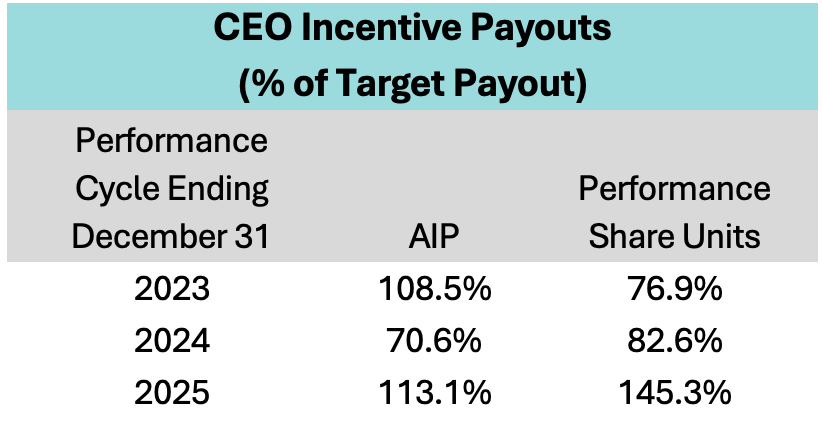
In setting 2025 AIP financial targets, the Committee considered our Annual Operating Plan (AOP), our prior year results, and whether any additional adjustments were appropriate. Our pay for performance alignment is illustrated by the 113.1% payout to our Enterprise NEOs, and a 104.0% payout to Ms. Engelhardt (Print). The Committee used the process and considerations for setting the 2025 AIP financial targets described in the table below for setting the 2025 AIP financial targets:
Process and Considerations in Setting 2025 AIP Financial Targets | ||||||||
Primary inputs for targets set in first quarter of 2025 | AOP | •Management develops and the board reviews and approves the AOP to ensure it is challenging, yet achievable, and consistent with the company's long-term strategy and financial goals •The Committee uses the AOP as a foundational element to set target goals for revenue, EBITDA and EPS | ||||||
Prior Year Actual Results | •Considered as a benchmark to ensure targets are realistic, challenging, and require growth for our ongoing business | |||||||
Divestitures of Businesses | •The Committee considers business acquisitions and divestitures in setting AIP targets to maintain the integrity and fairness of the AIP; no adjustments for acquisitions or divestitures were made in 2025 | |||||||
| Setting of targets | •Targets require growth in the ongoing business (i.e., the respective target must exceed the prior year actuals after adjustment for divestitures) | |||||||
The table below shows each of the 2025 AIP financial targets for the NEOs, along with the corresponding 2024 reported financial measure. Targets required growth over the 2024 reported performance, with the exception of the Print segment, where we anticipated continued secular decline. Because we seek to reward NEOs for results related to our ongoing business, the final column indicates the percentage growth required over 2024 comparable adjusted results, or, in the case of the Print business, the better than planned secular decline. Importantly, and as discussed above, the Committee ensured the 2025 Enterprise targets for each metric, at a minimum, matched the prior year reported measure.
Financial Metric | 2024 Reported1 | 2024 Comparable Adjusted2 | 2025 Target | 2025 Growth Required at Target Performance | ||||||||||
Enterprise Revenue (in thousands) | $2,121,761 | $2,110,999 | $2,140,000 | 1.4% | ||||||||||
Print Revenue (in thousands) | $1,205,077 | $1,205,077 | $1,167,000 | -3.2% | ||||||||||
| Enterprise Adjusted EBITDA (in thousands) | $412,075 | $406,453 | $430,000 | 5.8% | ||||||||||
Enterprise Adjusted EPS | $3.29 | $3.26 | $3.49 | 7.1% | ||||||||||
(1)See our Annual Report on Form 10-K for the fiscal year ended December 31, 2024.
(2)In 2024, the divestiture of our Canadian payroll business resulted in the following approximate impacts: $11 million revenue impact, $6 million EBITDA impact, and $0.03 EPS impact. Comparable adjusted revenue, comparable adjusted EBITDA, and comparable adjusted EPS are non-GAAP financial measures. See Annex A for a reconciliation of comparable adjusted results to reported.
After setting financial performance targets, the Committee set ranges around these targets to provide a structured and measurable way to reward executives for achieving threshold to maximum levels of performance outcomes, ensuring that incentives are meaningful and challenging. No payouts are made on a financial metric if the threshold performance requirement for that metric is not met. This structure helps mitigate excessive risk-taking, ensures payouts are competitive and market-aligned, and provides a clear framework for assessing performance and determining payouts.
The following table summarizes the 2025 AIP threshold and maximum performance requirements relative to the financial targets and the corresponding payout percentages.
11
Performance Level | Enterprise Comparable Adjusted EBITDA | Enterprise Comparable Adjusted EPS | Enterprise Comparable Adjusted Revenue | Business Unit Revenue | Payout (% of target) | ||||||||||||
| Maximum (% of Target) | ≥ 110.0% of AOP | ≥ 115.0% of AOP | ≥ 110.0% of AOP | ≥ 110.0% of AOP | 200% | ||||||||||||
| Target | 100% | 100% | 100% | 100% | 100% | ||||||||||||
| Threshold (% of Target) | 92% of AOP | 87% of AOP | 92.5% of AOP | 92.5% of AOP | 50% | ||||||||||||
| Below Threshold | — | — | — | — | 0% | ||||||||||||
Strategic Initiatives
The Committee believes strategic initiatives ensure that executives are focused on achieving important objectives that contribute to overall business success and create growth opportunities for future success. For this metric of the AIP, the Committee identified areas of focus related to specific strategic goals of the company and its segments. The Committee assessed the company's performance in each of these areas, which included a quantitative assessment of each initiative, followed by a qualitative assessment of overall company performance and management's efforts. The following table summarizes the quantifiable portion of the 2025 AIP strategic initiative goals identified by the Committee:
Strategic Initiative | Threshold | Target | Maximum | ||||||||
| Enterprise: completion of North Star EBITDA implementation | ≥ $22M | $34M | $52M | ||||||||
| Merchant Services: enablement of continued portfolio growth | ≥ 16 | 24 | 49 | ||||||||
| B2B Payments: enablement of accelerated growth trajectory | ≥ 1,646 | 2,533 | 6,839 | ||||||||
| Data Solutions: sustaining and accelerating the growth trajectory | ≥ 45 | 70 | 95 | ||||||||
| Print: maintain Check revenue and profitability and improve Promotional Solutions revenue | ≥ 92% retention/ 210 new logos | 95% retention/ 322 new logos | 99% retention/ 435 new logos | ||||||||
The results of the strategic initiatives listed above for our Enterprise and business segments are as follows:
•Enterprise completion of North Star EBITDA implementation realized $46M against a target of $34M, resulting in 167% payout on that strategic initiative
•Merchant Services realized a result of 48 new distribution partners against a target of 24, resulting in 198% payout on that strategic initiative
•B2B Payments realized portfolio growth of 5,016 active customers and enabled DPN lockboxes against a target of 2,533, resulting in 158% payout on that strategic initiative
•Data Solutions realized 76 new logos between DDM and Bankers Dashboard against a target of 70, resulting in 124% payout on that strategic initiative
•Print realized a 97% retention rate for Check against a target of 95%, resulting in 148% payout on that strategic initiative; and 312 new Promotional Solutions logos against a target of 322, resulting in a 91% payout; total combined payout for the Print segment strategic initiatives was 119%
AIP Target Payouts
The target payouts under the AIP for each of the NEOs are expressed as a percentage of base salary paid during the year and are generally set at or near the median of competitive market data based on comparisons against compensation surveys and our Peer Group. The 2025 target incentive percentages are displayed in the following table for each of the NEOs and are unchanged from 2024.
| Name | Target Annual Incentive as % of Base Salary | ||||
| Barry C. McCarthy | 120% | ||||
| William C. Zint | 75% | ||||
Tracey G. Engelhardt | 75% | ||||
| Yogaraj Jeyaprakasam | 75% | ||||
Jeffrey L. Cotter | 75% | ||||
12
2025 AIP Results
Based on our fiscal 2025 results, the outcomes and corresponding payouts for the 2025 AIP financial metrics are shown in the following table, relative to the targets and ranges:
| Metric | Metric Weighting | Threshold | Target | Maximum | ||||||||||
| Enterprise Comparable Adjusted Revenue (in thousands) | 40% for Enterprise NEOs | $1,980,000 | $2,140,000 | $2,354,000 | ||||||||||
| Print Revenue (in thousands) | 40% for Print NEO | $1,079,000 | $1,167,000 | $1,280,000 | ||||||||||
| Enterprise Comparable Adjusted EBITDA (in thousands) | 30% | $395,600 | $430,000 | $473,000 | ||||||||||
| Enterprise Comparable Adjusted EPS | 10% | $3.04 | $3.49 | $4.01 | ||||||||||
We performed well across all metrics:
•Enterprise comparable adjusted revenue result was $2,133M against a target of $2,140M; performance resulted in a formulaic payout of 97.9% of target.
•Print revenue result was $1,137M against a target of $1,167M; performance resulted in a formulaic payout of 82.7% of target.
•Enterprise comparable adjusted EBITDA result was $431.5M against a target of $430.0M; performance resulted in a formulaic payout of 100.4% of target.
•Enterprise comparable adjusted EPS result was $3.61 against a target of $3.49; performance resulted in a formulaic payout of 120.9% of target.
The strategic initiatives represent 20% of the overall bonus potential, with 10% tied to enterprise strategic initiatives and 10% tied to segment-specific strategic initiatives, which resulted in a formulaic payout of:
•For the Enterprise strategic initiatives, the blended result is weighted 50% towards the enterprise North Star initiative and 50% towards the blended average of all the business unit strategic initiative results. The resulting blended average result was 158.5%.
•For Ms. Engelhardt and the Print business unit, the blended result is weighted 50% towards the enterprise North Star initiative and 50% towards the blended average of the Print business unit strategic initiative results. The resulting blended average result was 143.3%.
Final Enterprise and Segment AIP results are shown in the following table:
| Enterprise Adjusted Revenue (40%) | Segment Adjusted Revenue (40%) | Enterprise Adjusted EBITDA (30%) | Adjusted EPS (10%) | Blended Strategic Initiatives (20%) | Blended Calculated Payout | |||||||||||||||
| Enterprise NEOs | 97.9% | N/A | 100.4% | 120.9% | 158.5% | 113.1% | ||||||||||||||
| Print (Ms. Engelhardt) | N/A | 82.7% | 100.4% | 120.9% | 143.3% | 104.0% | ||||||||||||||
The table below reflects the actual AIP payout received by each NEO:
| Name | 2025 Eligible Base Salary ($) | Target as a % of Base Salary | Award at Target ($) | Payout as a % of Target | Actual Payout ($) | ||||||||||||
| Barry C. McCarthy | 950,000 | 120% | 1,140,000 | 113.1% | $1,289,340 | ||||||||||||
| William C. Zint | 600,000 | 75% | 450,000 | 113.1% | $508,950 | ||||||||||||
| Tracey G. Engelhardt | 620,000 | 75% | 465,000 | 104.0% | $483,600 | ||||||||||||
| Yogaraj Jeyaprakasam | 597,500 | 75% | 448,125 | 113.1% | $506,829 | ||||||||||||
| Jeffrey L. Cotter | 565,000 | 75% | 423,750 | 113.1% | $479,261 | ||||||||||||
The amounts earned by all NEOs under the AIP for 2025 are included in the "Non-Equity Incentive Plan Compensation" column of the SCT appearing later in this Proxy Statement.
13
Long-Term Incentive Compensation
Our long-term incentive compensation utilizes our Stock Plan to provide our NEOs with equity awards that are directly linked to the value provided to our shareholders. It is designed and administered to balance and achieve several critical objectives for our executive compensation program:
•supports and rewards the achievement of our long-term business strategy and objectives;
•encourages decisions and behavior intended to increase shareholder value;
•reinforces the pay-for-performance orientation of the overall executive compensation program;
•enables us to attract and retain high-quality key executive talent by providing competitive incentive and total compensation opportunities; and
•promotes share ownership and facilitates achievement of the stock ownership guidelines.
Long-term equity incentive compensation for our NEOs generally is set at or near the median of long-term equity incentive compensation paid to executives of companies of similar size and in similar positions using the data gathered from compensation surveys and our Peer Group. All annual equity awards made to our NEOs and other recipients are targeted to be on the same annual grant date, except for awards made in conjunction with an individual's promotion or hire date or as necessary to facilitate retention of key employees. We do not time our equity awards to take advantage of market conditions or the release of earnings or other major announcements by us.
Components of Long-Term Incentive Awards
The following table describes the designs of the equity awards granted to the NEOs in 2025, consisting of a mix of PSUs and RSUs:
| Grant Type | Vesting | Weight | Performance Metrics | Purpose | ||||||||||
| PSUs | 3-year cliff | 50% | Three-year revenue (50% of PSUs) | •Revenue is included because of the continued secular decline in the Print business, which continues to generate a significant portion of our revenue; emphasizes the importance of increasing revenue overall, which is critical for short- and long-term success •Revenue acts as a primary motivator for executives, driving performance excellence and aligning their interests with the company's financial and business success | ||||||||||
| Three-year free cash flow (50% of PSUs) | •Free cash flow is a measure of our financial health, supporting our ability to pay dividends and reduce debt •Free cash flow is crucial to our strategy for investing in the growth opportunities of our Merchant Solutions, B2B Payments and Data Solutions businesses | |||||||||||||
| Relative TSR modifier (+/- 25% of final payouts) | •Relative TSR aligns the interests of executives with those of shareholders •The Committee believes TSR motivates the creation of long-term shareholder value, encouraging the NEOs to focus on achieving superior performance compared to other companies in the same industry | |||||||||||||
| RSUs | 3-year ratable | 50% | •Align the interests of the NEOs with those of our shareholders by providing an ownership stake in the company •Serves as a retention tool, encouraging the NEOs to remain with the company through the vesting period | |||||||||||
2025 PSU Metrics and Terms
For PSUs granted in 2025, the three-year performance targets for revenue and free cash flow are based on three-year cumulative revenue and cumulative free cash flow targets that were established at the beginning of the three-year period. Importantly, the targets are set in alignment with our long-range plan to create shareholder value. We will disclose the specific performance targets for these PSUs in 2028, after the end of the performance period, as we consider them to be strategically and commercially sensitive.
14
At the end of the three year cycle, performance will be evaluated on a scale and the payouts will vary accordingly, as described in the following tables:
| Performance as % of Target | |||||||||||
| Performance Level | Adjusted Revenue (50% weight in PSUs) | Adjusted Free Cash Flow (50% weight in PSUs) | Payout as % of Target Payout1 | ||||||||
| Below Threshold | Below 90% | Below 80% | 0% | ||||||||
| Threshold | 90% | 80% | 50% | ||||||||
| Target | 100% | 100% | 100% | ||||||||
| Maximum or Above | 106% | 110% | 200% | ||||||||
(1)No payouts are made for achievement below the threshold. If achievement is at or above the threshold, payouts are determined by linear interpolation for performance between the threshold and target levels and between the target and maximum levels.
Following determination of each financial metric payout in accordance with the chart above, final PSU payout results are subject to a three-year relative TSR modifier, utilizing a formula that may increase or decrease final participant payouts by up to 25%. Payout modification is based on a relative TSR ranking within a list of publicly traded companies that are constituents of the Russell 3000 index and are categorized within the Commercial & Professional Services and Software & Services GICS industries. Upon completion of the performance period, the relative TSR modifier is determined based on the following table:
| Relative TSR Modifier | |||||||||||
| 3-Year Relative TSR Ranking | Below 25th Percentile | 25th to 75th Percentile | Above 75th Percentile | ||||||||
| Modifier | -25% (final payout decreased 25%) | 0% (final payout unchanged) | +25% (final payout increased 25%) | ||||||||
The final measurements of performance for the PSU metrics are subject to reasonable adjustments, including unknown or unanticipated items, whether favorable or unfavorable, to the calculation of the performance goals as determined by the Committee. Examples include, but are not limited to, acquisitions, partnerships, divestitures, changes in tax law, or regulatory changes. Historically, if targets are attained, PSUs have been converted to shares. However, the PSU award agreements allow our board discretion to pay out any earned amounts in cash or stock.
2025 RSU Terms
RSUs vest in equal one-third increments on each of the first three anniversaries of the grant date. These awards are intended to further align the interests of the recipients with those of our shareholders, while promoting executive retention. These awards accrue dividend equivalents that are only paid out upon vesting.
2025 Awards
The following table details the target grant date fair value used by the Committee to determine the number of PSUs and RSUs awarded to each NEO in 2025, which are disclosed in the "Grants of Plan-Based Awards" table below. The actual value of equity awards that may be realized by the NEOs will depend on their continued service, the performance of the company, and our future stock price performance.
| Name | Target Grant Value ($) | Target PSUs Granted (#) | Target RSUs Granted (#) | ||||||||
| Barry C. McCarthy | 5,500,000 | 153,976 | 153,975 | ||||||||
| William C. Zint | 1,200,000 | 33,594 | 33,595 | ||||||||
| Tracey G. Engelhardt | 1,425,000 | 39,894 | 39,894 | ||||||||
| Yogaraj Jeyaprakasam | 1,100,000 | 30,796 | 30,795 | ||||||||
| Jeffrey L. Cotter | 1,000,000 | 27,996 | 27,996 | ||||||||
The Target Grant Value in the table above for Mr. McCarthy remained unchanged from the previous year, as the Committee determined that this grant value was competitive and aligned with market practices. The value for Mr. Zint increased to $1,200,000 in 2025, from $1,150,000 in 2024. The value for Ms. Engelhardt increased to $1,425,000 in 2025, from $1,200,000 in 2024. The value for Mr. Jeyaprakasam increased to $1,100,000 in 2025, from $900,000 in 2024. The value for Mr. Cotter increased to $1,000,000 in 2025, from $950,000 in 2024. Each increase was to align each NEO's target long-term incentive opportunity to competitive market levels.
15
2023–2025 PSU Award Payouts
Our 2023 PSU award goals were set in the first quarter of fiscal year 2023 and included equally weighted performance targets. Half of the PSUs targeted a three-year cumulative revenue value. The target revenue for each of the years was calculated using a 2% year-over-year fixed growth rate applied to the prior year actual revenue. The other half were based on a three-year cumulative free cash flow goal. The target cumulative free cash flow for each of the years was calculated using a 22% year-over-year fixed growth rate applied to the prior year actual free cash flow. Additionally, both the cumulative revenue and the cumulative free cash flow payouts are subject to a three-year relative TSR modifier measured against our three-year relative TSR ranking within a list of publicly traded companies that are constituents of the Russell 3000 index and that are categorized within the Commercial & Professional Services and Software & Services GICS industries. At the end of the three year cycle, performance and payouts were evaluated as described in the following tables, the scale is detailed in above table titled Performance as % of Target:
| LTIP Revenue Calculation 2023-2025 | ||||||||||||||
| Year | Baseline (Prior Year Actual) ($) | Fixed Growth Rate (%) | Target ($) | Actual ($) | ||||||||||
| 2022 Baseline | $2,238 | |||||||||||||
| 2023 (in millions) | $2,238 | 2% | $2,283 | $2,192 | ||||||||||
| 2024 (in millions) | $2,192 | 2% | $2,236 | $2,111 | ||||||||||
| 2025 (in millions) | $2,111 | 2% | $2,153 | $2,133 | ||||||||||
Adjustments for M&A1 | $1102 | |||||||||||||
| 3-year Cumulative Totals | $6,672 | $6,546 | ||||||||||||
| Percent Revenue Attainment | 98.1% | |||||||||||||
(1)As previously disclosed, divestitures of our webhosting, logo, and payroll businesses occurred throughout this multi-year period. The $110M represents the total amount of revenue divested after the baseline was set. See our quarterly and annual SEC filings for further details on those divestitures.
(2)These impacts were reported as Exits in our revenue disclosures for 2022.
| LTIP Free Cash Flow Calculation 2023-2025 | ||||||||||||||
| Year | Baseline (Prior Year Actual) ($) | Fixed Growth Rate (%) | Target ($) | Actual ($) | ||||||||||
| 2022 Baseline | $87 | |||||||||||||
| 2023 (in millions) | $87 | 22% | $106 | $98 | ||||||||||
| 2024 (in millions) | $98 | 22% | $119 | $100 | ||||||||||
| 2025 (in millions) | $100 | 22% | $122 | $175 | ||||||||||
Adjustments for M&A1 | $15 | |||||||||||||
| 3-year Cumulative Totals | $347 | $388 | ||||||||||||
| Percent Free Cash Flow Attainment | 111.9% | |||||||||||||
(1)As previously disclosed, divestitures of our webhosting, logo, and payroll businesses occurred throughout this multi-year period. Adjusted EBITDA from business exits totaled $30M in 2022, $26M in 2023, $6M in 2024, and $0 in 2025. A conservative estimate of 25% of the adjusted EBITDA from business exits was applied to approximate the annual impacts to Free Cash Flow from these divestitures. As a result, the $15M M&A adjustment is the sum of each year’s business exit adjusted EBITDA applied against this 25% factor. See our quarterly and annual SEC filings for further details on those divestitures.
After the conclusion of 2025, the blended performance payout for the 2023-2025 PSU awards was determined to be 145.3%. The payout for the cumulative revenue was 90.6% The payout for the cumulative free cash flow was 200%. The relative TSR was 11.8% with a 72.7% percentile rank. The relative TSR modifier payout was 0% based on the company's TSR performance compared to that within an index of publicly traded companies in the Russell 3000 Commercial & Professional Services and Software & Services GICS industries, as of the beginning of the performance period.
Retirement Benefits
We provide our NEOs with benefits available to other eligible U.S. employees. Our qualified retirement savings plan (the 401(k) Plan and Roth 401(k) Plan) that, when in effect, includes a company match of the employee's pre-tax and after-tax contributions. Our retirement plans are regularly compared with retirement programs of companies that are in businesses similar to ours and/or are located in geographic areas from which we typically recruit talent to help
16
ensure that we remain competitive in the market. The incremental value of benefits provided to our NEOs under this program is included in the All Other Compensation column of the SCT.
Security Benefits
The company offers security measures for employees when warranted, based on an evaluation of role-related and location-based risk. These measures are intended to support safe and secure business operations and are not treated as personal perks, as they stem from the individual’s employment responsibilities. However, disclosure rules require that certain security-related expenses be reported as personal benefits for the President and CEO and other NEOs in the SCT.
Given the visibility of the President and CEO and other NEOs and the results of a formal threat assessment, the following services were provided, and the related expenses are included in the table: security personnel at primary residences; security personnel while on our property; and a vehicle and security driver.
For third-party security providers, the Company reports the incremental contractor expenses associated with personal-time protection. The reported amount reflects the additional out-of-pocket costs directly tied to protecting the executive during personal time.
Other Benefits
Our NEOs and certain other executives are eligible to participate in our tax-deferred compensation plans. The Deluxe Corporation Deferred Compensation Plan is intended to promote executive retention by providing a long-term savings opportunity on a tax-efficient basis. Under this plan, which complies with the requirements of Section 409A of the Internal Revenue Code of 1986, as amended (Section 409A), NEOs and other key employees may choose to defer up to 100 percent of their base salary (less applicable deductions) and up to 50% of any AIP payout into multiple investment options. Contributions for the NEOs under this provision for 2025 are reflected in the All Other Compensation column of the SCT. The investment options are similar to the investment options available to employees in our broad-based retirement plans. The majority of payouts from this plan commence following termination of employment, based on elections made by the participants in accordance with, and subject to, any delays in payment that otherwise might be required by Section 409A.
Additional benefits include customary medical, dental, life and disability insurance.
Our President and CEO is provided a supplemental long-term disability insurance plan that restores benefits lost due to a salary cap that applies to our broad-based employee long-term disability plan, in which he also participates. The total benefit, combining the supplemental and broad-based plans, equates to the amount that would otherwise result from the broad-based plan if the salary were uncapped.
Compensation Design Process
The Committee meets several times annually to fulfill duties and responsibilities set forth in its charter, including evaluating and approving compensation philosophies, policies, plans, and programs for NEOs. The Committee reviews total compensation packages (base salary, annual cash incentives, long-term incentives, and benefits) and compares them to market standards. In the first quarter, it determines any salary increases, verifies annual incentive results and PSU payouts, sets performance measures and incentive targets for the year, and grants long-term equity awards. The President and CEO's performance is reviewed by the Committee, with input from the other non-employee members of the board.
Role of our CEO and our Human Resources Organization
Our President and CEO evaluates the performance of other NEOs and makes compensation recommendations to the Committee. Our Human Resources team collaborates with FW Cook to provide information and to aid in the design and management of our compensation programs.
Compensation Consultant Services and Independence
The Committee has the authority to engage independent advisors to assist it in fulfilling its responsibilities. The Committee has retained FW Cook, a national executive compensation consulting firm, to provide advice with respect to compensation for our NEOs and other officers. FW Cook performs services solely on behalf of the Committee and does not provide any other services to us.
17
FW Cook performed the following services for the Committee in 2025: prepared and reviewed market benchmarking data for the President and CEO and other NEOs to assist the Committee in determining appropriate levels of compensation; reviewed the methodology on which compensation is based and designed, including reviewing the Peer Group for continued appropriateness; prepared and reviewed market data on the design and competitiveness of non-employee director compensation; informed the Committee of current updates regarding trends in executive and director compensation; reviewed tally sheets; assessed incentive risk and other proxy disclosures; and reviewed regulatory and governance guidance. FW Cook attended meetings upon invitation and participated in executive sessions without management present.
Management has no separate relationship with FW Cook. We make regular payments to FW Cook for its services regarding executive and non-employee director compensation, including meeting preparation and attendance, advice, and best practice information, as well as competitive data. Pursuant to SEC rules, the Committee assessed the independence of FW Cook, including based on information provided by FW Cook, and concluded that no conflict of interest exists that would prevent FW Cook from independently representing the Committee.
Management of Compensation-Related Risk
In establishing and reviewing our executive compensation program, the Committee considers whether the program encourages unnecessary or excessive risk-taking and has concluded that it does not. We have a robust process of evaluating our compensation plans, programs and practices, which includes a risk analysis of myriad compensation design features. This evaluation occurs annually and is reviewed by FW Cook and provided to the Committee for review. The Committee reviewed our material compensation programs and noted numerous ways in which risk is effectively managed or mitigated. All such plans were deemed to have substantial risk mitigating features, including the following: a balanced mix of fixed and variable pay and short- and long-term incentives; use of multiple performance measures; a portfolio of long-term incentives, including time-based and performance-based measures; caps, discretion in payment, oversight by non-plan participants and significant stock ownership guidelines; pre-approval requirements for executive stock transactions; and the existence of policies prohibiting stock hedging and pledging and requiring executive incentive compensation recoupment in specified circumstances.
The Committee also considers the effect compensation plans could have on risks to the company, including how compensation programs for employees generally impact individual behavior that could exacerbate these enterprise risks. Board and management processes are in place to oversee risk associated with compensation programs and practices, including, but not limited to, regular business reviews, alignment of compensation plan goals with our annual and long-term strategic goals and performance expectations, review of enterprise risk management by the board as part of the annual strategy and budget reviews, and other appropriate internal controls. The Committee concluded that our compensation plans, programs and policies, considered as a whole, including applicable risk-mitigation features, are not reasonably likely to have a material adverse effect on our results or operations.
Stock Ownership Guidelines for Executive Officers
The Committee has established stock ownership guidelines for executive officers which prohibit them from selling stock unless a minimum level of ownership is achieved. The Committee annually reviews each executive officer's progress toward attaining his or her ownership target. The guidelines are as follows:
•five times annual base salary for the President and CEO;
•two and one half times annual base salary for other NEOs; and
•NEOs have five years to achieve the guidelines from the date the individual becomes subject to the guidelines.
For purposes of calculating the stock ownership of the NEOs under these guidelines, stock options are not included. While RSUs convertible into shares are included, prior to vesting, only 60% of their value is counted toward the ownership target. Our rationale is that approximately 40% of such units will be withheld or surrendered by the executive upon vesting to cover taxes. In addition to the stock ownership guidelines, executive officers are subject to share retention and holding period requirements. Under this policy, individuals who have not achieved their ownership targets must retain 100% of their net shares (i.e., shares remaining after exercise costs and applicable taxes are covered) upon the exercise of stock options and the vesting of other equity awards and are required to hold the shares until their individual ownership targets are met. All of our NEOs are in compliance with these guidelines.
18
Insider Trading Policy; Prohibitions on Pledging and Hedging Company Stock
We also maintain an insider trading policy that governs the purchase, sale and other dispositions of our securities by directors, officers and employees. It is also our policy that the company will not engage in open market transactions in our securities while aware of material nonpublic information relating to the company or our securities. Our insider trading policy is designed to promote compliance with insider trading laws, rules and regulations and any applicable listing standards. The policy also prohibits directors and executive officers from pledging our stock and from engaging in any transactions intended to hedge the economic risk of ownership in our stock. This policy prohibits executive officers and directors from directly or indirectly (i) purchasing any financial instrument or entering into any transaction that is designed to hedge or offset any decrease in the market value of our stock, including, but not limited to, prepaid forward contracts, short sales, equity swaps or collars, or (ii) pledging, hypothecating, or otherwise encumbering shares of our stock as collateral for indebtedness. This prohibition includes, but is not limited to, holding such shares in a margin account where such shares are used as collateral for a loan.
Policies on Clawback of Incentive Compensation
Historically, we have had in place an Incentive Compensation Recovery Policy, which applied to our officers who are subject to Section 16 of the Exchange Act. An updated Incentive Compensation Recovery Policy was adopted on August 15, 2023, ensuring compliance with all Dodd-Frank regulatory requirements.
The policy is summarized as follows:
•The policy requires reimbursement or forfeiture of any excess incentive compensation received by an executive, current or former, during the three fiscal years immediately preceding any accounting restatement, regardless of fault or misconduct.
•The amount to be recovered will approximate the amount by which the executive's incentive compensation for the relevant period exceeded amounts that would have been earned based on the restated financial results.
•The policy also allows the board to require reimbursement or forfeiture of incentive compensation, including all time-vesting equity awards, in the event an executive engages in detrimental conduct, including, but not limited to, willful violations of law, fraud, or gross misconduct.
While our recovery policy applies to incentive compensation earned by or awarded to executives on or after the date the policy was effective, our Stock Plan contains a similar provision requiring recoupment of excess incentive compensation earned under all awards if a restatement occurs within 12 months following the relevant performance period and the executive's misconduct contributed to the need for such restatement.
Consideration of Certain Tax Effects
Section 162(m) of the U.S. Internal Revenue Code, as amended (Section 162(m)), imposes a $1,000,000 annual deduction limit on compensation payable to certain current and former executive officers. The Committee believes that shareholder interests are best served if its discretion and flexibility in structuring and awarding compensation is not restricted by tax considerations. Therefore, the Committee seeks to maintain equity incentive compensation at levels needed to attract and retain named executive officers essential to our success, even though all or part of that compensation may not be deductible by reason of the Section 162(m) limitation.
Compensation and Talent Committee Report
The Compensation and Talent Committee has reviewed and discussed with management the foregoing Compensation Discussion and Analysis. Based on our review and discussion with management, we have recommended to the Board of Directors that the Compensation Discussion and Analysis be included in this Proxy Statement and be incorporated by reference into Deluxe Corporation's Annual Report on Form 10-K for the year ended December 31, 2025.
| MEMBERS OF THE COMPENSATION AND TALENT COMMITTEE | |||||
| Paul R. Garcia, Chair | Cheryl E. Mayberry McKissack | ||||
| Michelle T. Collins | Thomas J. Reddin | ||||
| Hugh S. (Beau) Cummins III | Telisa L. Yancy | ||||
19
COMPENSATION TABLES
The following tables present compensation for our NEOs and should be read in conjunction with the CD&A.
SUMMARY COMPENSATION TABLE
| Name and Principal Position | Year | Salary ($) | Bonus ($) | Stock Awards1 ($) | Option Awards ($) | Non-Equity Incentive Plan Compensation2 ($) | Change in Pension Value and Nonqualified Deferred Compensation Earnings3 ($) | All Other Compensation4 ($) | Total ($) | ||||||||||||||||||||
Barry C. McCarthy President and Chief Executive Officer | 2025 | 950,000 | — | 5,227,467 | — | 1,289,340 | — | 70,516 | 7,537,323 | ||||||||||||||||||||
| 2024 | 950,000 | — | 5,308,392 | — | 804,840 | — | 61,826 | 7,125,058 | |||||||||||||||||||||
| 2023 | 943,750 | — | 5,329,797 | — | 1,228,763 | — | 34,409 | 7,536,719 | |||||||||||||||||||||
William C. Zint Senior Vice President, Chief Financial Officer | 2025 | 600,000 | — | 1,140,534 | — | 508,950 | — | 9,000 | 2,258,484 | ||||||||||||||||||||
| 2024 | 575,000 | — | 1,109,935 | — | 304,463 | — | 12,075 | 2,001,473 | |||||||||||||||||||||
| 2023 | 475,000 | — | 823,691 | — | 386,531 | — | 19,415 | 1,704,637 | |||||||||||||||||||||
Tracey G. Engelhardt Senior Vice President, President, Print | 2025 | 620,000 | — | 1,354,401 | — | 483,600 | 5,866 | 10,340 | 2,474,207 | ||||||||||||||||||||
| 2024 | 615,000 | — | 1,158,188 | — | 325,643 | 5,889 | 37,097 | 2,141,817 | |||||||||||||||||||||
| 2023 | 575,000 | — | 1,162,882 | — | 471,169 | 6,436 | 59,324 | 2,274,811 | |||||||||||||||||||||
Yogaraj Jeyaprakasam Senior Vice President, Chief Technology and Digital Officer | 2025 | 597,500 | — | 1,045,506 | — | 506,829 | 13,878 | 8,165 | 2,171,878 | ||||||||||||||||||||
| 2024 | 586,250 | — | 868,632 | — | 310,420 | 12,326 | 12,275 | 1,789,903 | |||||||||||||||||||||
| 2023 | 556,250 | — | 872,152 | — | 452,649 | 3,324 | 18,424 | 1,902,799 | |||||||||||||||||||||
Jeffrey L. Cotter Senior Vice President, Chief Administrative Officer, General Counsel and Corporate Secretary | 2025 | 565,000 | — | 950,464 | — | 479,261 | 294 | 10,025 | 2,005,044 | ||||||||||||||||||||
| 2024 | 561,250 | — | 916,905 | — | 297,182 | (2,157) | 12,755 | 1,785,935 | |||||||||||||||||||||
(1)Amounts in this column reflect the aggregate grant date fair value computed in accordance with ASC Topic 718 for awards of stock during the fiscal years ended December 31, 2025, 2024 and 2023, except for Mr. Cotter for whom we are only reporting 2025 and 2024. Assumptions used in the calculation of these amounts are included in Note 10 to our Consolidated Financial Statements filed as part of our Annual Report on Form 10-K for the fiscal year ended December 31, 2025. These amounts reflect an accounting expense and do not necessarily correspond to the actual value that may be realized by the NEOs. Stock awards included in this column are comprised of annual long-term equity incentive compensation consisting of RSUs and PSUs received under the Stock Plan.
The value of the PSUs included in this column for 2025 assumes target performance over the measurement period. Assuming threshold, target and maximum performance, the value of the PSUs, which includes cumulative revenue PSUs and cumulative free cash flow PSUs, are as follows:
| Name | Threshold ($) | Target ($) | Maximum ($) | ||||||||
| Barry C. McCarthy | 1,238,737 | 2,477,474 | 4,954,948 | ||||||||
| William C. Zint | 270,280 | 540,527 | 1,081,055 | ||||||||
| Tracey G. Engelhardt | 320,963 | 641,894 | 1,283,789 | ||||||||
| Yogaraj Jeyaprakasam | 247,754 | 495,508 | 991,015 | ||||||||
| Jeffrey L. Cotter | 225,228 | 450,456 | 900,911 | ||||||||
For more information regarding the 2025 grants of RSUs and PSUs, see the Grants of Plan-Based Awards Table.
(2)Amounts listed in this column reflect cash amounts paid to the NEOs under the AIP.
(3)This amount reflects the above-market value of earnings on compensation deferred by the NEOs in our non-qualified Deferred Compensation Plan. Earnings on deferred compensation are considered above-market to the extent they exceed that which would have occurred if the amount had been invested at 120% of the applicable federal long-term rate in the given year of compensation.
(4)For all NEOs, amounts in the "All Other Compensation" column for 2025 include varied 401(k) contributions. For Messrs. McCarthy, Jeyaprakasam, and Cotter, the amount also includes a $200 HSA contribution for each. For Ms. Engelhardt and Mr. Cotter, the amount also includes a cell phone allowance of $480 for each. Mr. McCarthy's total also includes $55,323 for residential and onsite security and $5,000 for personal-event security services.
20
GRANTS OF PLAN-BASED AWARDS
All Other Stock Awards: Number of Shares of Stock or Units3 (#) | Grant Date Fair Value of Stock and Option Awards4 ($) | |||||||||||||||||||||||||||||||
| Name & Grant Date | Estimated Future Payouts Under Non-Equity Incentive Plan Awards1 | Estimated Future Payouts Under Equity Incentive Plan Awards2 | ||||||||||||||||||||||||||||||
| Award Type | Threshold ($) | Target ($) | Max ($) | Threshold (#) | Target (#) | Max (#) | ||||||||||||||||||||||||||
| Barry C. McCarthy | ||||||||||||||||||||||||||||||||
| 2/19/2025 | RSU | 153,975 | 2,749,994 | |||||||||||||||||||||||||||||
| 2/19/2025 | CFCF PSU | 38,494 | 76,988 | 153,976 | 1,238,737 | |||||||||||||||||||||||||||
| 2/19/2025 | CR PSU | 38,494 | 76,988 | 153,976 | 1,238,737 | |||||||||||||||||||||||||||
| AIP Cash | 570,000 | 1,140,000 | 2,280,000 | |||||||||||||||||||||||||||||
| William C. Zint | ||||||||||||||||||||||||||||||||
| 2/19/2025 | RSU | 33,595 | 600,007 | |||||||||||||||||||||||||||||
| 2/19/2025 | CFCF PSU | 8,399 | 16,797 | 33,594 | 270,264 | |||||||||||||||||||||||||||
| 2/19/2025 | CR PSU | 8,399 | 16,797 | 33,594 | 270,264 | |||||||||||||||||||||||||||
| AIP Cash | 225,000 | 450,000 | 900,000 | |||||||||||||||||||||||||||||
| Tracey G. Engelhardt | ||||||||||||||||||||||||||||||||
| 2/19/2025 | RSU | 39,894 | 712,507 | |||||||||||||||||||||||||||||
| 2/19/2025 | CFCF PSU | 9,974 | 19,947 | 39,894 | 320,947 | |||||||||||||||||||||||||||
| 2/19/2025 | CR PSU | 9,974 | 19,947 | 39,894 | 320,947 | |||||||||||||||||||||||||||
| AIP Cash | 232,500 | 465,000 | 930,000 | |||||||||||||||||||||||||||||
| Yogaraj Jeyaprakasam | ||||||||||||||||||||||||||||||||
| 2/19/2025 | RSU | 30,795 | 549,999 | |||||||||||||||||||||||||||||
| 2/19/2025 | CFCF PSU | 7,699 | 15,398 | 30,796 | 247,754 | |||||||||||||||||||||||||||
| 2/19/2025 | CR PSU | 7,699 | 15,398 | 30,796 | 247,754 | |||||||||||||||||||||||||||
| AIP Cash | 224,063 | 448,125 | 896,250 | |||||||||||||||||||||||||||||
| Jeffrey L. Cotter | ||||||||||||||||||||||||||||||||
| 2/19/2025 | RSU | 27,996 | 500,009 | |||||||||||||||||||||||||||||
| 2/19/2025 | CFCF PSU | 6,999 | 13,998 | 27,996 | 225,228 | |||||||||||||||||||||||||||
| 2/19/2025 | CR PSU | 6,999 | 13,998 | 27,996 | 225,228 | |||||||||||||||||||||||||||
| AIP Cash | 211,875 | 423,750 | 847,500 | |||||||||||||||||||||||||||||
(1)Reflects the estimated range of potential payouts under the AIP for 2025. The actual cash payouts under the AIP are reflected in the Non-Equity Incentive Plan Compensation column of the SCT.
(2)For all NEOs, the PSUs were granted under our Stock Plan as part of our long-term equity incentive compensation. The PSUs are subject to the following performance conditions: three-year cumulative free cash flow (CFCF PSUs) and three-year cumulative revenue (CR PSUs), both of which are subject to a relative TSR modifier during the period January 1, 2025 through December 31, 2027. These PSUs vest, if at all, upon satisfaction of the conditions and subsequent approval of the Committee.
(3)For all NEOs, the RSUs granted under our Stock Plan vest in equal one-third increments on each of the first three anniversaries of the grant date.
(4)Dollar values represent the accounting grant date fair value of PSUs and RSUs. The value of the RSUs are based upon the closing price on the grant date of $17.86. For all PSU awards, the values are based upon a Monte Carlo simulation value of $16.09 per share.
For more information on the awards described in the Grants of Plan-Based Awards Table, refer to the "Annual Incentive Compensation" and "Long-Term Equity Incentive Compensation" sections in the CD&A, as well as "Severance and Change of Control Arrangements" for how these awards are treated under various termination and change of control scenarios.
21
OUTSTANDING EQUITY AWARDS AT FISCAL YEAR-END
| Option Awards | |||||||||||||||||
| Name | Grant Date1 | Number of Securities Underlying Unexercised Options (# Exercisable) | Number of Securities Underlying Unexercised Options2 (# Unexercisable) | Option Exercise Price ($) | Option Expiration Date | ||||||||||||
Barry C. McCarthy | 4/1/2019 | 128,205 | — | 44.69 | 4/1/2029 | ||||||||||||
| 2/19/2020 | 200,382 | — | 39.11 | 2/19/2030 | |||||||||||||
| 3/1/2021 | 104,167 | — | 41.27 | 3/1/2031 | |||||||||||||
| William C. Zint | 3/1/2021 | 3,906 | — | 41.27 | 3/1/2031 | ||||||||||||
Tracey G. Engelhardt | 4/1/2019 | 10,684 | — | 44.69 | 4/1/2029 | ||||||||||||
| 2/18/2020 | 20,772 | — | 39.62 | 2/18/2030 | |||||||||||||
| 3/1/2021 | 13,021 | — | 41.27 | 3/1/2031 | |||||||||||||
| Yogaraj Jeyaprakasam | — | — | — | — | — | ||||||||||||
Jeffrey L. Cotter | 4/1/2019 | 32,051 | — | 44.69 | 4/1/2029 | ||||||||||||
| 2/18/2020 | 38,947 | — | 39.62 | 2/18/2030 | |||||||||||||
| 3/1/2021 | 19,531 | — | 41.27 | 3/1/2031 | |||||||||||||
(1)For better understanding of this table, we have included an additional column showing the grant dates of options.
(2)All unexercisable options vest ratably over a four-year period following the grant date.
| Stock Awards | |||||||||||||||||
| Name | RSU Grant Date/ PSU Period1 | Number of Shares or Units Held, Not Vested (#) | Market Value of Shares or Units, Not Vested2 ($) | Equity Incentive Plan Awards: Number of Unearned Shares, Units, or Other Rights, Not Vested (#) | Equity Incentive Plan Awards: Market or Payout Value of Unearned Shares, Units or Other Rights, Not Vested2 ($) | ||||||||||||
| Barry C. McCarthy | 2/16/20223 | 17,345 | 387,314 | ||||||||||||||
2/15/20234 | 46,889 | 1,047,031 | |||||||||||||||
2/14/20244 | 91,897 | 2,052,060 | |||||||||||||||
2/19/20254 | 153,975 | 3,438,262 | |||||||||||||||
1/1/2023 - 12/31/20255 | 32,370 | 877,874 | |||||||||||||||
1/1/2023 - 12/31/20255 | 71,259 | 1,932,544 | |||||||||||||||
1/1/2024 - 12/31/20266 | 34,461 | 769,514 | |||||||||||||||
1/1/2024 - 12/31/20267 | 34,461 | 769,514 | |||||||||||||||
1/1/2025 - 12/31/20278 | 38,494 | 859,571 | |||||||||||||||
1/1/2025 - 12/31/20279 | 38,494 | 859,571 | |||||||||||||||
| William C. Zint | 2/16/20223 | 1,156 | 25,813 | ||||||||||||||
2/15/20234 | 7,247 | 161,826 | |||||||||||||||
2/14/20244 | 19,215 | 429,071 | |||||||||||||||
2/19/20254 | 33,595 | 750,176 | |||||||||||||||
1/1/2023 - 12/31/20255 | 5,461 | 148,102 | |||||||||||||||
1/1/2023 - 12/31/20255 | 11,803 | 320,097 | |||||||||||||||
1/1/2024 - 12/31/20266 | 7,206 | 160,899 | |||||||||||||||
1/1/2024 - 12/31/20267 | 7,206 | 160,899 | |||||||||||||||
1/1/2025 - 12/31/20278 | 8,399 | 187,539 | |||||||||||||||
1/1/2025 - 12/31/20279 | 8,399 | 187,539 | |||||||||||||||
| Tracey G. Engelhardt | 2/16/20223 | 3,083 | 68,843 | ||||||||||||||
2/15/20234 | 10,231 | 228,458 | |||||||||||||||
2/14/20244 | 20,050 | 447,717 | |||||||||||||||
2/19/20254 | 39,894 | 890,833 | |||||||||||||||
1/1/2023 - 12/31/20255 | 8,098 | 219,618 | |||||||||||||||
1/1/2023 - 12/31/20255 | 17,627 | 478,044 | |||||||||||||||
1/1/2024 - 12/31/20266 | 7,519 | 167,888 | |||||||||||||||
1/1/2024 - 12/31/20267 | 7,519 | 167,899 | |||||||||||||||
1/1/2025 - 12/31/20278 | 9,974 | 222,708 | |||||||||||||||
1/1/2025 - 12/31/20279 | 9,974 | 222,708 | |||||||||||||||
22
| Name | RSU Grant Date/ PSU Period1 | Number of Shares or Units Held, Not Vested (#) | Market Value of Shares or Units, Not Vested2 ($) | Equity Incentive Plan Awards: Number of Unearned Shares, Units, or Other Rights, Not Vested (#) | Equity Incentive Plan Awards: Market or Payout Value of Unearned Shares, Units or Other Rights, Not Vested2 ($) | ||||||||||||
| Yogaraj Jeyaprakasam | 2/16/20223 | 4,163 | 92,960 | ||||||||||||||
2/15/20234 | 7,673 | 171,338 | |||||||||||||||
2/14/20244 | 15,038 | 335,799 | |||||||||||||||
2/19/20254 | 30,795 | 687,652 | |||||||||||||||
1/1/2023 - 12/31/20255 | 6,199 | 168,117 | |||||||||||||||
1/1/2023 - 12/31/20255 | 13,435 | 364,357 | |||||||||||||||
1/1/2024 - 12/31/20266 | 5,639 | 125,919 | |||||||||||||||
1/1/2024 - 12/31/20267 | 5,639 | 125,919 | |||||||||||||||
1/1/2025 - 12/31/20278 | 7,699 | 171,919 | |||||||||||||||
1/1/2025 - 12/31/20279 | 7,699 | 171,919 | |||||||||||||||
| Jeffrey L. Cotter | 2/16/20223 | 2,891 | 64,556 | ||||||||||||||
2/15/20234 | 6,394 | 142,778 | |||||||||||||||
2/14/20244 | 15,874 | 354,466 | |||||||||||||||
2/19/20254 | 27,996 | 625,151 | |||||||||||||||
1/1/2023 - 12/31/20255 | 4,414 | 119,708 | |||||||||||||||
1/1/2023 - 12/31/20255 | 9,485 | 257,233 | |||||||||||||||
1/1/2024 - 12/31/20266 | 5,952 | 132,908 | |||||||||||||||
1/1/2024 - 12/31/20267 | 5,953 | 132,919 | |||||||||||||||
1/1/2025 - 12/31/20278 | 6,999 | 156,288 | |||||||||||||||
1/1/2025 - 12/31/20279 | 6,999 | 156,288 | |||||||||||||||
(1)For better understanding of this table, we have included an additional column showing the grant dates of RSUs and PSUs.
(2)Based on the $22.33 per share closing price of our common stock on December 31, 2025.
(3)RSUs vest ratably over four years.
(4)RSUs vest ratably over three years.
(5)The PSUs granted for the 2023-2025 performance period exceeded their payout thresholds. The cumulative revenue threshold was 50% and paid out at 90.6%. The cumulative free cash flow threshold was 50% and paid out at 200%. Amounts in the table represent actual payouts, which are discussed in more detail in the "Long-Term Equity Incentive Compensation" section in the CD&A.
(6)PSUs with cumulative free cash flow metrics are shown assuming achievement of the threshold goal of 50% based upon a fixed growth rate resetting plan. A more detailed discussion can be found in the "Long-Term Equity Incentive Compensation" section in the CD&A.
(7)PSUs with cumulative revenue metrics are shown assuming achievement of the threshold goal of 50% based upon a fixed growth rate resetting plan. A more detailed discussion can be found in the "Long-Term Equity Incentive Compensation" section in the CD&A.
(8)PSUs with cumulative revenue metrics are shown assuming achievement of the threshold of 50% based upon a three-year cumulative plan. A more detailed discussion can be found in the "Long-Term Equity Incentive Compensation" section in the CD&A.
(9)PSUs with cumulative free cash flow metrics are shown assuming achievement of the threshold of 50% based upon a three-year cumulative plan. A more detailed discussion can be found in the "Long-Term Equity Incentive Compensation" section in the CD&A.
2025 STOCK VESTED
| RSUs | PSUs | |||||||||||||
| Name | Number of Shares Acquired on Vesting (#) | Value Realized on Vesting1 ($) | Number of Shares Acquired on Vesting (#) | Value Realized on Vesting1 ($) | ||||||||||
| Barry C. McCarthy | 116,239 | 2,171,014 | 57,343 | 1,342,973 | ||||||||||
| William C. Zint | 18,645 | 348,413 | — | — | ||||||||||
| Tracey G. Engelhardt | 24,096 | 451,127 | 10,194 | 238,743 | ||||||||||
| Yogaraj Jeyaprakasam | 19,354 | 352,674 | 13,765 | 322,376 | ||||||||||
| Jeffrey L. Cotter | 18,356 | 342,200 | 9,558 | 223,848 | ||||||||||
(1)Value realized equals the closing price of our common stock on the vesting date multiplied by the number of shares vested.
Non-Qualified Deferred Compensation
Our Deferred Compensation Plan permits eligible employees to defer annually the receipt of up to 100% of base salary, and up to 50% of annual cash bonuses. In connection with this plan, we have created a non-qualified grantor trust (commonly known as a Rabbi Trust) through which our obligations under the plan are funded. No assets are set aside
23
for individual participants in the plan, and the trust assets remain subject to the claims of our creditors. Amounts deferred under the plan are payable on the earliest to occur of a change of control of our company, the participant's termination of employment, disability or death, or the date for payment selected by the participant, unless a delay in payments is otherwise required by Section 409A. Deferred amounts are credited with gains and losses based on the performance of deemed investment options (i.e., phantom funds) selected by the participant. We also may make ERISA excess payments and/or contributions of benefit plan equivalents to participants' accounts if IRS limits or the deferrals made by a participant under this plan have the effect of reducing the contributions they otherwise would receive from us under our qualified benefit plans.
The following table summarizes activity under these plans for each of the NEOs during 2025:
NON-QUALIFIED DEFERRED COMPENSATION TABLE
Executive Contributions in Last Fiscal Year | Aggregate Earnings in Last Fiscal Year1 | Aggregate Withdrawals/Distributions in Last Fiscal Year | Aggregate Balance at Last Fiscal Year-End | |||||||||||
| Name | ($) | ($) | ($) | ($) | ||||||||||
| Barry C. McCarthy | — | — | — | — | ||||||||||
| William C. Zint | — | — | — | — | ||||||||||
| Tracey G. Engelhardt | — | 8,189 | — | 51,907 | ||||||||||
| Yogaraj Jeyaprakasam | 121,834 | 52,303 | — | 415,474 | ||||||||||
| Jeffrey L. Cotter | — | 7,196 | — | 137,073 | ||||||||||
(1)Amounts represent earnings on contributions and deferrals made in 2025 and in prior years. Participants in this plan allocate their deferrals into phantom funds similar to the funds available under our qualified retirement plans. Any amounts reported reflect the performance of these phantom funds.
The measurement funds available under the Deferred Compensation Plan, and their annualized returns as of December 31, 2025, are as follows:
| Fund | Asset Category | Ticker | Rate of Return (%) | ||||||||
| Vanguard Federal Money Market Investor | Money Market-Taxable | VMFXX | 4.21 | ||||||||
| Vanguard VIF Total Bond Market Index | Intermediate Core Bond | N/A | 6.52 | ||||||||
| Vanguard Large-Cap Index Fund Admiral Shares | Large Blend | VLCAX | 18.10 | ||||||||
| Vanguard Growth Index Admiral | Large Growth | VIGAX | 19.49 | ||||||||
| Vanguard Small Cap Index Admiral | Small Blend | VSMAX | 9.44 | ||||||||
| Vanguard Developed Markets Index Admiral | Foreign Large Blend | VTMGX | 35.80 | ||||||||
| Vanguard VIF Equity Index | Large Cap Blend | VVAEQIV | 18.27 | ||||||||
| Vanguard Emerging Markets Stock Index Admiral | Diversified Emerging Markets | VEMAX | 24.72 | ||||||||
Severance and Change of Control Arrangements
Severance Arrangements
Our severance arrangements are intended to facilitate each NEO's attention to the affairs of our business and to recognize each executive's key role within our organization. The severance plan for our executive officers and the severance provisions in Mr. McCarthy's employment agreement are collectively referred to as severance arrangements. Receipt of the benefits described below is conditioned upon Mr. McCarthy or the NEO entering into a release of certain claims. The NEOs are also required by their severance arrangements to maintain the confidentiality of our confidential information after their termination and to comply with any applicable non-competition and non-solicitation obligations to which they have previously agreed.
Mr. McCarthy's employment agreement provides that if he is terminated by us without Cause or he resigns for Good Reason, as those terms are defined in his agreement, he will be entitled to receive 12 months of base salary, payable in accordance with our regular payroll cycle over 12 months, and up to 12 additional months of base salary, subject to offset for earned income from other full-time employment, which he must use reasonable efforts to pursue. He will also be entitled to up to 12 months of health coverage premium continuation if he elects coverage and to executive-level outplacement services.
The severance plan applicable to the other NEOs provides that if a NEO is terminated by us without Cause or the NEO terminates employment for Good Reason, as those terms are defined in the plan, the NEO will be entitled to receive 12 months of salary, which may be paid in a lump sum or over time with the company's regular payroll, reimbursement for executive-level outplacement services in an amount up to $25,000, and a lump sum payment of $20,000 to cover other expenses incurred in connection with employment transition.
24
Change in Control Arrangements
Mr. McCarthy's employment agreement provides that if he is terminated by us without Cause or he resigns for Good Reason within 24 months following a Change in Control, as those terms are defined in his agreement, he will be entitled to receive two times the sum of his annual base salary plus his target annual incentive bonus, payable in a lump sum, and up to 12 months of health coverage premium continuation if he elects coverage. All severance payments are conditioned upon Mr. McCarthy signing a release of claims and otherwise complying with his contractual obligations.
The executive severance plan applicable to the other NEOs provides that if a NEO is terminated following a Change in Control, or the NEO terminates employment for Good Reason following a Change in Control, as those terms are defined in the plan, the NEO will be entitled to receive 18 months of salary payable in a lump sum, reimbursement for executive-level outplacement services in an amount up to $25,000, and a lump sum payment of $20,000 to cover other expenses incurred in connection with employment transition. All severance payments are conditioned upon the NEO complying with his or her contractual obligations.
Treatment of Equity Awards
In the event of a Change of Control, as defined in the award agreements, our NEOs' outstanding long-term equity incentive awards are subject to the following terms:
•for RSUs (including dividend equivalents), PSUs and options not assumed by the acquiring or surviving entity and replaced with interests covering other publicly traded securities, vesting will fully accelerate (based on target performance for PSUs), and PSUs will be paid out as soon as practicable following the Change of Control, and options will become exercisable prior to and terminate effective upon the Change of Control;
•for RSUs and options assumed by the acquiring or surviving entity and replaced with interests covering other publicly traded securities, the award agreements provide that the awards will remain governed by their pre-Change of Control terms except that, in the event of involuntary termination without Cause or voluntary resignation for Good Reason within 12 months following the Change of Control, any unvested RSUs and options will fully vest, with RSUs (and related dividend equivalents) paying out as soon as practicable following vesting, and options remaining exercisable for one year post-termination; and
•for PSUs assumed by the acquiring or surviving entity and replaced with other publicly traded securities, the award agreements provide that PSUs will remain governed by their pre-Change of Control terms, except that, in addition to the vesting acceleration upon a termination without Cause described below, in the event of voluntary resignation for Good Reason after the first anniversary of the commencement of the relevant performance period and within 12 months following the Change of Control, the unvested PSUs will vest on a pro rata basis, although any payout will be based on actual performance and will not occur until actual performance against target is determined at the end of the performance period.
In the event of a death, Disability, or Approved Retirement (as those terms are defined in the applicable award agreements), our NEOs’ outstanding awards are subject to the following terms:
•RSU awards provide for full, accelerated vesting and payout (with related dividend equivalents) as soon as practicable thereafter;
•option awards provide for full, accelerated vesting if the event occurs after the first anniversary of the grant date, with a one-year post-termination exercise period following death or Disability, and a 3-year post-termination exercise period following Approved Retirement; and
•PSU awards provide for vesting on a pro rata basis if the event occurs after the first anniversary of the commencement of the relevant performance period; however, payout is based on actual performance and does not occur until actual performance against target is determined at the end of the performance period.
In the event of termination without Cause, as defined in the award agreements, our NEOs’ outstanding awards are subject to the following terms:
•options and the next installment of RSUs (and related dividend equivalents) vest on a pro rata basis, provided the termination is after the first anniversary of the award date, with a 3-month exercise period for options, and payout of the vested RSUs (and related dividend equivalents) as soon as practicable thereafter, and provided further, that if a NEO meets the "rule of 75", meaning the NEO's combined age and years of service are at least 75, the RSU awards would fully accelerate and vest upon Committee approval; and
•PSUs vest on a pro rata basis, provided the termination is after the first anniversary of the commencement of the relevant performance period; however, payout is based on actual performance and does not occur until actual performance against target is determined at the end of the performance period.
If a NEO engages in competitive activity, solicits our employees or current or potential customers, fails to properly hold our confidential information, or is terminated for Cause, then the options, RSUs, and PSUs (vested and unvested amounts) are subject to forfeiture, and any amounts paid upon settlement of such awards (including dividend equivalents) and gains upon exercise of options, in each case, within the preceding 12 months, are subject to repayment.
25
The foregoing summary is qualified in its entirety by reference to the complete text of Mr. McCarthy's employment agreement, the severance plan, and the forms of stock option, RSU, and PSU award agreements, all of which are filed, or incorporated by reference, as exhibits to our Annual Report on Form 10-K for the fiscal year ended December 31, 2025.
26
PAYMENTS MADE UPON TERMINATION
The following table illustrates the aggregate payments that would be received by the NEOs, assuming a hypothetical qualifying termination event occurring on December 31, 2025. To the extent an amount due includes the value of any equity acceleration, such value is based upon the number of equity awards that would have vested if termination occurred on the last business day of fiscal 2025 and the closing price of our common stock as of that date, $22.33 per share.
| Name | Change in Control1 ($) | Without Cause2 ($) | Death or Disability3 ($) | Approved Retirement3 ($) | ||||||||||
| Barry C. McCarthy | ||||||||||||||
| Cash Severance | 4,180,000 | 1,900,000 | — | — | ||||||||||
| Benefit Continuation | 43,840 | 43,840 | — | — | ||||||||||
| Other Cash | — | 25,000 | — | — | ||||||||||
| Acceleration of RSUs | 6,924,667 | 2,156,674 | 6,924,667 | — | ||||||||||
Acceleration of PSUs4 | 6,516,341 | 3,198,132 | 3,198,132 | — | ||||||||||
Acceleration of Stock Options5 | — | — | — | — | ||||||||||
| Total | 17,664,848 | 7,323,646 | 10,122,799 | — | ||||||||||
| William C. Zint | ||||||||||||||
| Cash Severance | 900,000 | 600,000 | — | — | ||||||||||
| Other Cash | 45,000 | 45,000 | — | — | ||||||||||
| Acceleration of RSUs | 1,366,886 | 330,565 | 1,366,886 | — | ||||||||||
Acceleration of PSUs4 | 1,195,266 | 582,403 | 582,403 | — | ||||||||||
Acceleration of Stock Options5 | — | — | — | — | ||||||||||
| Total | 3,507,152 | 1,557,968 | 1,949,289 | — | ||||||||||
| Tracey G. Engelhardt | ||||||||||||||
| Cash Severance | 930,000 | 620,000 | — | — | ||||||||||
| Other Cash | 45,000 | 45,000 | — | — | ||||||||||
| Acceleration of RSUs | 1,402,891 | 1,402,891 | 1,402,891 | 1,402,891 | ||||||||||
Acceleration of PSUs4 | 1,339,906 | 638,614 | 638,614 | 638,614 | ||||||||||
Acceleration of Stock Options5 | — | — | — | — | ||||||||||
| Total | 3,717,797 | 2,706,505 | 2,041,505 | 2,041,505 | ||||||||||
| Yogaraj Jeyaprakasam | ||||||||||||||
| Cash Severance | 930,000 | 620,000 | — | — | ||||||||||
| Other Cash | 45,000 | 45,000 | — | — | ||||||||||
| Acceleration of RSUs | 1,287,749 | 357,230 | 1,287,749 | — | ||||||||||
Acceleration of PSUs4 | 1,191,350 | 565,009 | 565,009 | — | ||||||||||
| Total | 3,454,099 | 1,587,239 | 1,852,758 | — | ||||||||||
| Jeffrey L. Cotter | ||||||||||||||
| Cash Severance | 847,500 | 565,000 | — | — | ||||||||||
| Other Cash | 45,000 | 45,000 | — | — | ||||||||||
| Acceleration of RSUs | 1,186,951 | 337,312 | 1,186,951 | — | ||||||||||
Acceleration of PSUs4 | 1,156,806 | 562,820 | 562,820 | — | ||||||||||
Acceleration of Stock Options5 | — | — | — | — | ||||||||||
| Total | 3,236,257 | 1,510,132 | 1,749,771 | — | ||||||||||
(1)Severance under Mr. McCarthy's employment agreement due to a Change in Control termination is equal to two times base salary plus his AIP bonus at 100% of target, and 12 months of health coverage premiums. Severance for all other NEOs under a Change in Control is equal to one-and-a-half times base salary, executive outplacement services (listed under "Other Cash"), and a lump sum employment transition payment (listed under "Other Cash"). All of our NEOs are also entitled to accelerated vesting of outstanding equity awards in accordance with the terms of each award agreement and as described above under "Treatment of Equity Awards." For purposes of this Change in Control column, equity awards are reflected as if they were not assumed by an acquiring entity upon a Change of Control.
(2)Severance under Mr. McCarthy's employment agreement due to termination without cause is equal to 12 months of base salary with the possibility of an additional 12 months offsetting earned income from other full-time employment, 12 months of health coverage premiums, and executive outplacement services (listed under "Other Cash"). Severance for all other NEOs under a termination without cause is equal to 12 months of base salary, a pro rata bonus, executive outplacement services (listed under "Other Cash"), and a lump sum employment transition payment (listed under "Other Cash"). The foregoing severance payments for Mr. McCarthy and the other NEOs also apply upon a resignation for Good Reason. All of our NEOs are also entitled to accelerated vesting of outstanding equity awards in accordance with the terms of each award agreement and as described above under "Treatment of Equity Awards." Because Ms. Engelhardt meets the rule of 75, upon Committee approval, Ms. Engelhardt's RSUs would fully accelerate and vest.
(3)For death, Disability, or Approved Retirement, each of our NEOs is entitled to a pro-rated bonus, and accelerated vesting of outstanding equity awards depending on the grant type and terms, as described above under "Treatment of Equity Awards." Because Ms. Engelhardt meets the rule of 75, she would be eligible for Approved Retirement, if granted by the Committee.
27
(4)For change in control, assumes that the acquiring entity did not replace the award with comparable equity, such that the PSUs vested completely assuming target performance levels. For all other termination scenarios in the table, assumes pro rata vesting and payout at target, even though actual payouts for such PSUs are made at such time as the measurement period has ended and actual performance levels are measured and calculated.
(5)Although stock options may vest depending on terms as described above under "Treatment of Equity Awards," because the exercise price of all our NEOs' outstanding options exceeded the closing price of our common stock on December 31, 2025, we have not reported any corresponding value to such accelerated vesting.
Regardless of the manner in which a NEO's employment terminates, the NEO is entitled to receive, subject to any applicable clawback provisions, certain previously earned compensation, including:
•AIP compensation earned during the fiscal year for certain termination causes, which include qualified retirement;
•vested shares awarded under our Stock Plan; and
•amounts contributed under the 401(k) Plan and executive compensation deferral programs.
These amounts are excluded from the table above.
CEO Pay Ratio
We are required by SEC rules and regulations to disclose a reasonable estimate of the ratio of the annual total compensation for our President and CEO to the annual total compensation of our median employee. For the year ended December 31, 2025, the annual total compensation for Mr. McCarthy was $7,537,323, as shown in the SCT, plus $26,503 for the cost of his employer-sponsored health and welfare benefits. The annual total compensation for our median employee was $75,650 calculated in accordance with SEC rules. For 2025, the annual total compensation of Mr. McCarthy was 99.98 times that of our median employee.
As of the measurement date, December 1, 2025, we had a total of 4,600 employees. For purposes of identifying our median employee, we used our United States and Canadian employee population of 4,587 total employees, of which 4,404 were employed in the U.S. and 183 were employed in Canada. We excluded 13 employees located in India. As permitted by SEC rules and regulations, we excluded leased employees and independent contractors. To determine our median employee, we used base salary for the 12-month period ending December 1, 2025, as our compensation measure that we applied consistently to all employees. We annualized this amount for permanent employees who commenced employment during that period. We also chose to include the cost of the median employee's employer-sponsored health and welfare benefits, including medical, dental and life insurance, as well as short- and long-term disability coverage, in the calculation of our median employee's total annual compensation. For Canadian employees, we converted their pay amounts to U.S. dollars using the spot rate as of December 1, 2025.
Pay Versus Performance Outcomes
The following table provides specified executive compensation and financial performance measures for our five most recently completed fiscal years.
| Year | Summary Compensation Table Total for CEO ($) | Compensation Actually Paid to CEO1 ($) | Average Summary Compensation Table Total for Other NEOs ($) | Average Compensation Actually Paid to Other NEOs2 ($) | Value of Initial Fixed $100 Investment Based On: | Net Income (in millions)5 ($) | Adjusted EBITDA (in millions)6 ($) | |||||||||||||||||||
Total Shareholder Return3 ($) | Peer Group Total Shareholder Return4 ($) | |||||||||||||||||||||||||
| 2025 | 7,537,323 | 10,608,668 | 2,225,937 | 2,827,816 | 99.9 | 97.0 | 82.2 | 431.5 | ||||||||||||||||||
| 2024 | 7,125,058 | 8,216,822 | 1,929,782 | 2,162,974 | 94.7 | 109.9 | 52.9 | 412.1 | ||||||||||||||||||
| 2023 | 7,536,719 | 8,979,508 | 1,992,744 | 2,238,170 | 85.1 | 94.1 | 26.2 | 417.1 | ||||||||||||||||||
| 2022 | 10,375,485 | 3,607,005 | 2,220,306 | 852,747 | 63.0 | 78.2 | 65.5 | 418.1 | ||||||||||||||||||
| 2021 | 7,822,945 | 8,028,794 | 2,050,605 | 1,802,766 | 113.4 | 108.9 | 62.8 | 407.8 | ||||||||||||||||||
(1)The dollar amounts reported in this column represent the amount of Compensation Actually Paid (CAP) to our President and CEO, Barry C. McCarthy, as computed in accordance with Item 402(v) of Regulation S-K. The dollar amounts do not reflect the actual amount of compensation earned by or paid to Mr. McCarthy during the applicable year. To calculate CAP to Mr. McCarthy, for each of the years shown, the following deductions and additions were made to the SCT total compensation:
| Reconciliation of CEO SCT Total to CAP | ||||||||||||||
| Year | SCT Total ($) | Equity Deductions from SCT Total(a) ($) | Equity Additions to SCT Total(b) ($) | CAP ($) | ||||||||||
| 2025 | 7,537,323 | (5,227,467) | 8,298,812 | 10,608,668 | ||||||||||
| 2024 | 7,125,058 | (5,308,392) | 6,400,156 | 8,216,822 | ||||||||||
| 2023 | 7,536,719 | (5,329,797) | 6,772,586 | 8,979,508 | ||||||||||
| 2022 | 10,375,485 | (4,871,517) | (1,896,963) | 3,607,005 | ||||||||||
| 2021 | 7,822,945 | (6,439,546) | 6,645,395 | 8,028,794 | ||||||||||
28
(a)Represents the grant date fair values of equity-based awards granted each year, as shown in the Stock Awards and Option Awards columns of the SCT.
(b)For each year, reflects the sum of the equity fair value categories described as follows, calculated in accordance with Item 402(v) of Regulation S-K:
| Year | Year-end fair value of awards granted in the year and outstanding and unvested at year-end ($) | Prior year-end to year-end change in fair value of awards granted in prior years and outstanding and unvested at year-end ($) | Fair value as of vesting date of awards granted and vested in the year ($) | Prior year-end to vesting-date change in fair value of awards granted in prior years that vested in the year ($) | Prior year-end fair value of awards granted in prior years that were forfeited in the year ($) | Value of dividends or other earnings paid on awards not otherwise reflected in the fair values ($) | Total Equity Additions to SCT Total ($) | ||||||||||||||||
| 2025 | 7,035,142 | 1,457,285 | — | (452,804) | — | 259,189 | 8,298,812 | ||||||||||||||||
| 2024 | 6,188,528 | 197,088 | — | (22,829) | (164,242) | 201,611 | 6,400,156 | ||||||||||||||||
| 2023 | 6,013,430 | 646,150 | — | 34,383 | — | 78,623 | 6,772,586 | ||||||||||||||||
| 2022 | 2,406,099 | (4,384,367) | — | (58) | — | 81,363 | (1,896,963) | ||||||||||||||||
| 2021 | 4,552,443 | 607,333 | — | 1,345,862 | — | 139,757 | 6,645,395 | ||||||||||||||||
(2)The dollar amounts reported in this column represent the average amount of CAP to the non-CEO named executive officers (“Other NEOs”) as a group, as computed in accordance with Item 402(v) of Regulation S-K. The dollar amounts do not reflect the actual average amount of compensation earned by or paid to the Other NEOs during the applicable year. The Other NEOs reflected in this and the preceding column consist of the following individuals: 2025—William C. Zint, Tracey G. Engelhardt, Yogaraj Jeyaprakasam and Jeffrey L. Cotter; 2024—William C. Zint, Tracey G. Engelhardt, Yogaraj Jeyaprakasam, and Jeffrey L. Cotter; 2023—William C. Zint, Tracey G. Engelhardt, Michael A. Reed, and Yogaraj Jeyaprakasam; 2022—William C. Zint, Scott C. Bomar, Christopher L. Thomas, Yogaraj Jeyaprakasam, and Michael A. Reed; 2021—Scott C. Bomar, Keith A. Bush, Christopher L. Thomas, Michael A. Reed, and Jeffrey L. Cotter. To calculate CAP to our Other NEOs for each of the years shown, the following deductions and additions were made to the SCT total compensation:
| Other NEOs Reconciliation of Average SCT Total to Average CAP | ||||||||||||||
| Year | SCT Total ($) | Equity Deductions from SCT Total(a) ($) | Equity Additions to SCT Total(b) ($) | CAP ($) | ||||||||||
| 2025 | 2,225,937 | (1,122,726) | 1,724,605 | 2,827,816 | ||||||||||
| 2024 | 1,929,782 | (1,013,415) | 1,246,607 | 2,162,974 | ||||||||||
| 2023 | 1,992,744 | (956,940) | 1,202,366 | 2,238,170 | ||||||||||
| 2022 | 2,220,306 | (1,197,255) | (170,304) | 852,747 | ||||||||||
| 2021 | 2,050,605 | (1,228,600) | 980,761 | 1,802,766 | ||||||||||
(a)Represents the grant date fair value of equity-based awards granted each year, as shown in the Stock Awards and Option Awards columns of the SCT.
(b)For each year, reflects the sum of the equity fair value categories described as follows, calculated in accordance with Item 402(v) of Regulation S-K:
| Year | Year-end fair value of awards granted in the year and outstanding and unvested at year-end ($) | Prior year-end to year-end change in fair value of awards granted in prior years and outstanding and unvested at year-end ($) | Fair value as of vesting date of awards granted and vested in the year ($) | Prior year-end to vesting-date change in fair value of awards granted in prior years that vested in the year ($) | Prior year-end fair value of awards granted in prior years that were forfeited in the year ($) | Value of dividends or other earnings paid on awards not otherwise reflected in the fair values ($) | Total Equity Additions to SCT Total ($) | ||||||||||||||||
| 2025 | 1,510,968 | 248,764 | — | (77,777) | — | 42,650 | 1,724,605 | ||||||||||||||||
| 2024 | 1,181,440 | 37,409 | — | 7,010 | (12,830) | 33,578 | 1,246,607 | ||||||||||||||||
| 2023 | 1,079,683 | 112,881 | — | (8,953) | — | 18,755 | 1,202,366 | ||||||||||||||||
| 2022 | 544,028 | (414,256) | — | (43,365) | (271,588) | 14,877 | (170,304) | ||||||||||||||||
| 2021 | 885,667 | 116,547 | — | 142,783 | (177,089) | 12,853 | 980,761 | ||||||||||||||||
(3)Assuming an initial investment of $100 on December 31, 2019, TSR assumes reinvestment of all dividends, if any, and reflects changes in the company’s share price since the assumed initial investment date.
(4)Represents the weighted Peer Group TSR, weighted according to the respective companies’ stock market capitalization at the beginning of each period for which a return is indicated. The peer group used for this purpose is the Dow Jones U.S. Support Services (DJUSIS) Index.
(5)Dollar values represent the amount of net income reported in our audited financial statements for the applicable year.
(6)See Annex A for a reconciliation of adjusted EBITDA, a non-GAAP financial measure, to the most directly comparable GAAP financial measure.
29
Additional Information
Following is a discussion of the relationship between CAP and our TSR, our peers' TSR, our net income, and our adjusted EBITDA:
•CAP vs. TSR–Because stock is a significant portion of our NEO compensation packages, as our TSR has fluctuated, so has the compensation realized by our NEOs. Similarly, the Peer Group TSR has also fluctuated.
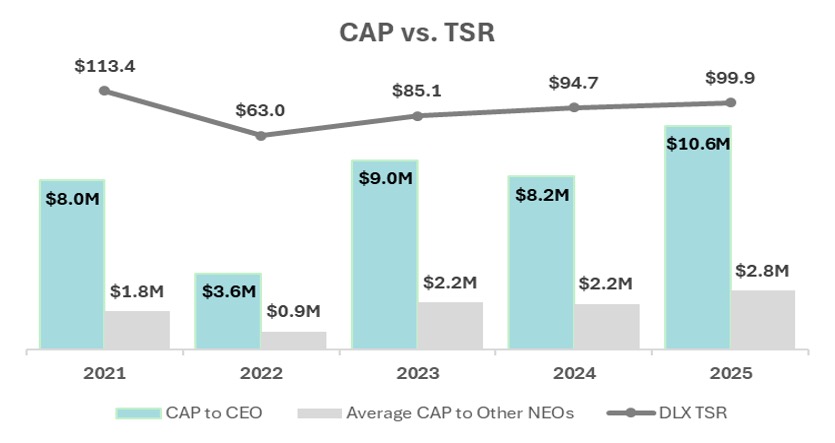
•CAP vs. Net Income–While the performance of our leadership team has resulted in an increase in net income over the past five years, the CAP to the team over this period has tracked more in line with our TSR.
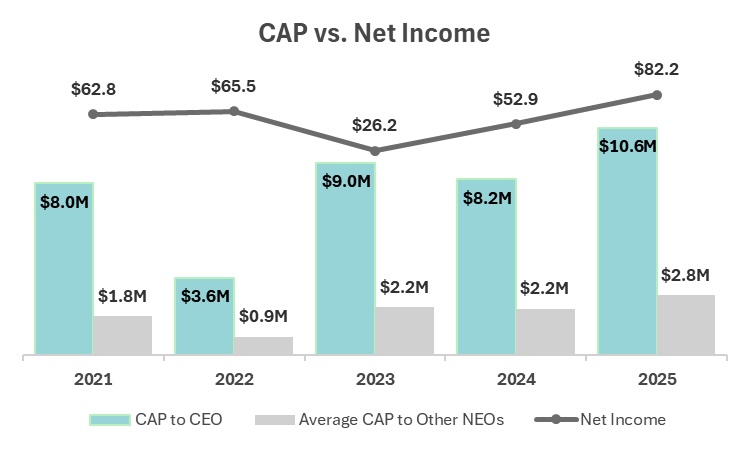
•CAP vs. Adjusted EBITDA–While the performance of our leadership team has resulted in an increase in adjusted EBITDA over the past five years, the CAP to the team over this period has tracked more in line with our TSR.
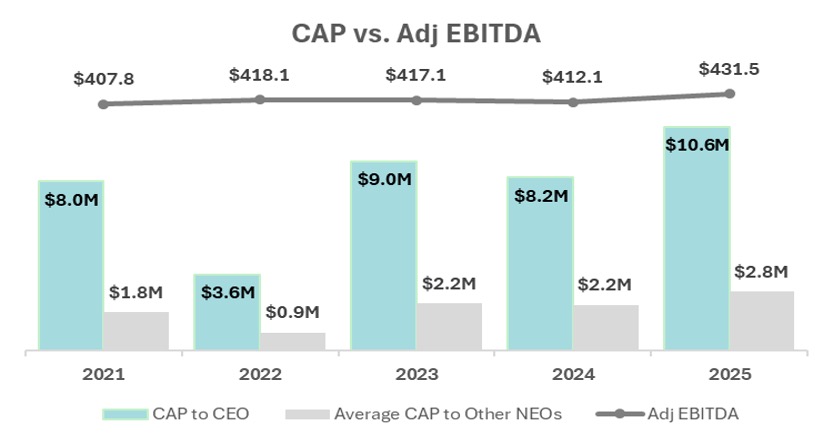
30
Most Important Performance Measures
For our fiscal 2025, adjusted EBITDA was identified as the most important financial performance measure in linking CAP to company performance and, accordingly, is included in the above Pay Versus Performance table. The other identified most important measures to CAP comprise the remaining performance measures used in our incentive plans. For further descriptions of these measures, including how they are calculated from our audited financial statements and how they are used in our incentive plans, see the CD&A section of this proxy statement. The following table lists the collective most important measures alphabetically:
| Tabular List of Most Important Measures | ||
| Adjusted EBITDA | ||
| Adjusted EPS | ||
| Adjusted Free Cash Flow | ||
| Adjusted Revenue | ||
| Relative TSR | ||
| Strategic Initiatives | ||
31